USB-C gets the headlines, and for good reason. But walk into a factory, a hospital equipment room, or a field-service depot and the connector population looks very different. Programmable logic controllers commissioned a decade ago still present Mini-USB service ports. Handheld scanners, older cameras, GPS units, and a long tail of measurement instruments still ship or ship with Micro-USB. The newest machines on the same floor run USB-C. Somebody has to keep all three alive, and that somebody is usually the person writing the cable specification.
This guide is written for that person. It compares Mini USB, Micro USB and USB-C on the attributes that decide a sourcing decision — mechanical retention, data capability, power capability, and what happens when the environment gets hostile — and it uses figures published in the manufacturer’s own technical documentation rather than generic marketing copy.
Why Legacy Connectors Are Still an Engineering Problem
The instinct when facing a mixed connector estate is to standardise on USB-C and be done with it. In practice that is rarely possible in one step, and the reason is not conservatism. It is that the connector is part of a certified assembly. Change the service port on a medical device or a piece of industrial equipment and you may trigger re-testing of the whole unit, not just the port. The cable is cheap; the re-certification is not.
The result is a long overlap period where three connector generations coexist on the same site. That overlap is manageable if it is planned. It becomes expensive when it is discovered, typically in one of two ways: a field engineer arrives with the wrong cable and the job is rescheduled, or a buyer orders “USB cables” in bulk and receives assemblies that are physically correct but electrically wrong for the application.
The second failure is the more insidious one, because it looks like success until it is installed. A cable that mates perfectly can still be limited to USB 2.0 speeds and slow charging, and the published technical guidance on this point is blunt: two cables can look identical while their internal wiring differs completely. Some support only 480 Mbps and slow charging; others are full-featured assemblies carrying 4K video, 10 Gbps data and 100 W charging in the same jacket.
The Three Connector Families, and Where Each One Came From
Understanding the genealogy helps predict behaviour in the field.
The Mini and Micro families belong to the USB 2.0 era. USB 2.0 was released in 2000 and delivered a High-Speed transfer rate of 480 Mbps, more than forty times faster than its predecessor, with power delivery up to 2.5 W. That was enough to make external drives, webcams and scanners genuinely practical, and it established the connector population still in service today: the flat rectangular USB-A for larger devices such as printers, and the smaller connectors for portable equipment. In published application guidance, USB mini cables are associated with devices requiring a smaller connector such as older cameras and GPS units, while USB micro cables are associated with smaller devices such as smartphones and tablets.
The next step change came with USB 3.0, introduced in 2008 and later re-branded USB 3.1 Gen 1, which brought the SuperSpeed protocol at a maximum theoretical 5 Gbps. That was achieved by adding internal wires to allow full-duplex communication, and the ports were typically coloured blue to distinguish them. Crucially, USB-A was designed to be backward compatible, which is the reason the ecosystem transitioned as smoothly as it did.
USB-C is the current endpoint of that line. It is a physical connector system built around a 24-pin double-sided design, which makes it reversible — there is no up or down. Published product documentation notes that it is roughly the size of the older Micro-USB plug while being far more capable, and that a single high-quality assembly can carry data, power and video simultaneously.
Comparison Table: Mini USB vs Micro USB vs USB-C
The table below compares the three families on the criteria that decide a purchase. Cells that depend on the specific assembly rather than the connector family are marked as assembly-dependent, because that is where most sourcing mistakes are made.
| Criterion | Mini USB | Micro USB | USB-C |
|---|---|---|---|
| Era and originating standard | USB 2.0 era | USB 2.0 era | Current generation, 24-pin double-sided |
| Orientation | Directional | Directional | Reversible, no up or down |
| Relative size | Smaller than USB-A | Smaller than USB-A; USB-C is roughly this size | Slim, oval |
| Typical host devices | Older cameras, GPS units, legacy service ports | Smartphones, tablets, smaller handheld devices | New laptops, industrial cameras, machine vision systems |
| Data capability | Assembly-dependent; USB 2.0 class assemblies run at 480 Mbps | Assembly-dependent; USB 2.0 class assemblies run at 480 Mbps | Assembly-dependent; documented up to 10 Gbps or 20 Gbps on capable assemblies |
| Power capability | Legacy-level, consistent with the 2.5 W USB 2.0 profile | Legacy-level | USB Power Delivery up to 100 W, and up to 240 W with the latest EPR standard |
| Video output | Not applicable | Not applicable | Yes on capable assemblies; 4K video documented |
| Retention under vibration | Friction only; a known weakness in moving equipment | Friction only | Friction only unless a locking variant is specified |
| Sourcing status | Legacy; plan for obsolescence | Legacy; still widely stocked | Current default for new designs |
What Actually Breaks in the Field
Connector failures in industrial environments cluster into three patterns, and they are rarely about the cable breaking cleanly in half.
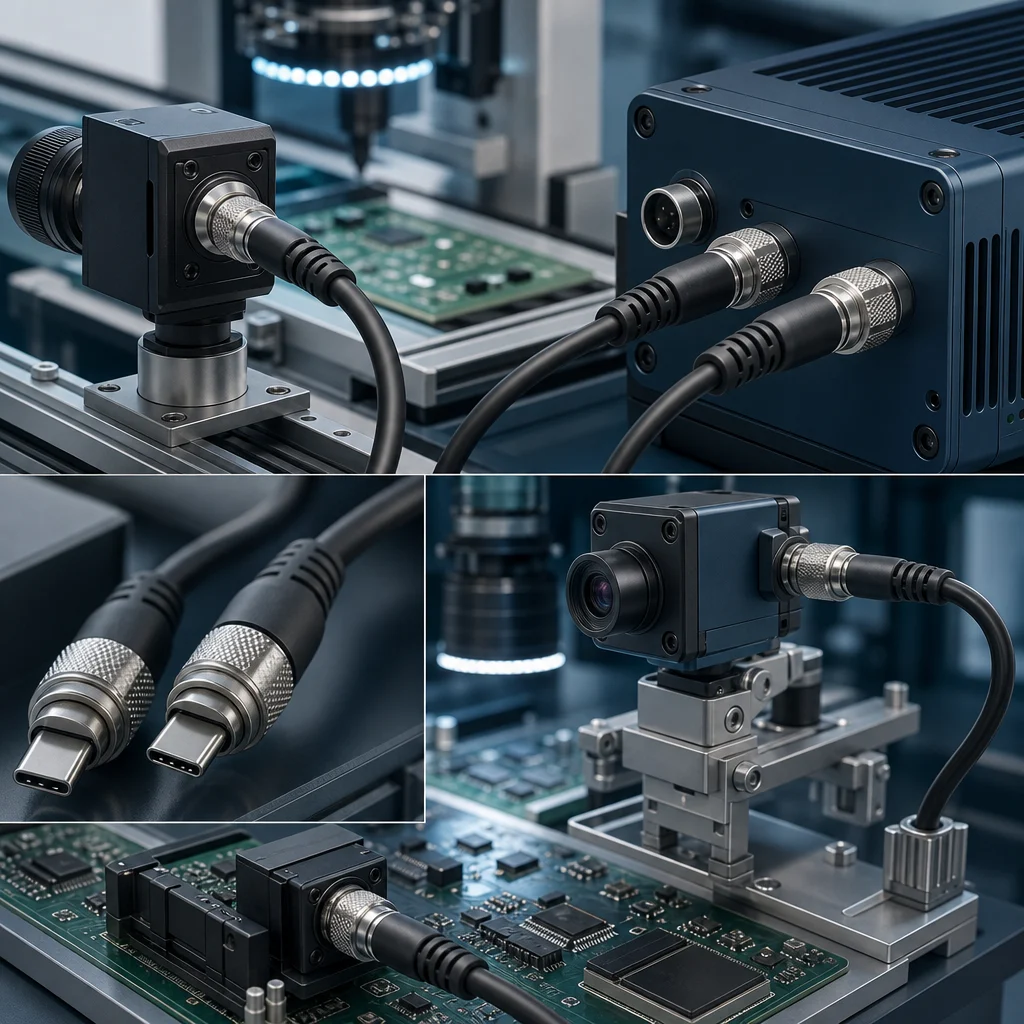
The first is retention. A friction-fit connector in a vibrating cabinet walks out over time. Published guidance on industrial USB-C is explicit that standard connectors can vibrate loose in factory settings, and that the mitigation is a locking design: connectors with single or dual screw locks on the housing, which bolt securely into the port and hold a stable connection for industrial cameras and machine vision systems even under intense vibration. If your equipment moves, this is not an optional upgrade.
The second is electrical mismatch. The connector mates, the device charges slowly or enumerates at the wrong speed, and nobody can see the problem because the physical layer looks fine. This is the failure mode behind the warning that a low-quality cable on a high-end device will bottleneck its performance. The specification fix is to state the required data rate and power level on the purchase order and require the supplier to confirm the assembly meets it, rather than ordering by connector shape.
The third is contamination and mechanical wear at the port. Legacy connectors on older equipment have often been mated hundreds of times by staff who were not thinking about connector life. By the time a replacement cable is ordered, the port on the device may be the real problem. A good diagnostic routine checks the device port before blaming the cable, and a good supplier will ask about the port condition rather than simply shipping a replacement.
A structured approach to these failure patterns, including how to isolate whether the fault sits in the cable, the connector or the port, is set out in the diagnostic guide to common cable failures.
Matching Power and Data to the Application
The numbers that matter are not the headline maximums. They are the values your device actually needs, stated clearly enough that a supplier can confirm or decline them.
On power, the scale runs from the legacy USB 2.0 profile of up to 2.5 W, through the typical 2.5 W to 5 W output of a standard USB-A port, to USB Power Delivery on USB-C at up to 100 W, and up to 240 W under the latest EPR standard. A single USB-C assembly at the high end can charge a phone, a tablet and a powerful laptop. If your application is a handheld scanner that trickle-charges overnight, specifying a 100 W assembly is waste without benefit; if it is an industrial camera drawing real power over the same cable, underspecifying is a field failure waiting to happen.
On data, the practical ladder runs 480 Mbps for USB 2.0 class work, 5 Gbps for SuperSpeed, and 10 or 20 Gbps on capable USB-C assemblies. Transferring configuration files to a legacy controller needs the first rung. Streaming uncompressed video from a machine vision camera does not. The mistake is assuming the connector implies the speed — it does not, and the documented example is stark: some USB-C cables support only USB 2.0 speeds and slow charging while others are full-featured.
There is a compliance dimension here too. A poorly made USB-C cable can draw too much power and damage the device it is connected to, which turns a five-dollar saving into a four-figure replacement. Certifications to look for on the supplier side include ISO 9001 and ISO 14001 for the manufacturing system, and CE and FCC compliance for the product.
Four Realistic Migration Paths
Once the estate is mapped, migration usually resolves into one of four patterns.
- Adapter bridging. The fastest fix for a mixed estate, connecting an existing USB-A or legacy device to a newer USB-C port. It solves today’s problem and adds a mechanical joint, so it suits bench and service environments rather than permanently vibrating installations.
- Hybrid assemblies. A single cable with a legacy connector at one end and USB-C at the other, built to a defined specification. This removes the adapter from the chain and is usually the right answer for equipment that is being kept but re-cabled.
- Locking USB-C retrofit. Where the device already has USB-C but the environment is hostile, moving to a screw-locking assembly addresses the retention failure without touching the device certification. This is the common pattern for industrial cameras and machine vision.
- Full redesign. Appropriate at end-of-life or when the device is being re-certified anyway. It is the most expensive path and the only one that removes the legacy connector from the bill of materials entirely.
The sequencing matters more than the choice. Standardising new purchases on USB-C while keeping a documented stock of legacy assemblies for installed base is usually cheaper than any forced conversion, and it avoids the trap of re-certifying equipment purely to retire a port.
Sourcing Checks Before You Commit
Five questions, asked before the purchase order, prevent most of the problems described above.
First: what data rate and power level must the assembly actually carry? Get it in writing on the order. Second: is a locking variant required? If the equipment vibrates, friction retention is not sufficient. Third: which certifications apply to your market and does the supplier hold them — ISO 9001 and ISO 14001 for the manufacturing system, CE and FCC for the product. Fourth: is the assembly full-featured or charge-only? The connector shape will not tell you. Fifth: what is the plan for the legacy end of the estate, and is the supplier able to support both generations rather than only the current one?
Manufacturer track record is worth weighing alongside the specification. Longkai Electronics, which has been producing cable assemblies since 2012 and supplies consumer and industrial customers including LG and CATL, publishes ISO 9001 and ISO 14001 certification and CE and FCC product compliance, with over 100 global partners — the kind of documentation that makes the certification answers quick and verifiable rather than promotional.
For the underlying standards background, the evolution of USB from a simple port to a universal powerhouse traces how each generation solved the problems of its time, and the USB-C explainer covers the connector’s power, data and video capability in detail.
Часто задаваемые вопросы
Are Mini USB and Micro USB the same connector?
No. They are distinct connector families from the same USB 2.0 era, and they are not interchangeable. Published application guidance associates Mini USB with devices needing a smaller connector such as older cameras and GPS units, and Micro USB with smaller devices such as smartphones and tablets. Check the device port before ordering rather than assuming.
Can I replace a Mini USB cable with a USB-C cable?
Not directly, because the connectors are physically different. The practical options are an adapter, a hybrid assembly with a legacy connector at one end and USB-C at the other, or a device-side port change — and the third option can trigger re-certification of the whole unit.
Why does my USB-C cable charge slowly when the connector fits perfectly?
Because the connector shape does not determine capability. Documented guidance notes that two physically identical cables can differ internally, with some supporting only USB 2.0 speeds and slow charging while others are full-featured assemblies carrying 4K video, 10 Gbps data and 100 W charging. Specify the required rate and power level explicitly.
What should I specify for equipment that vibrates?
A locking connector. Standard USB connectors can vibrate loose in factory settings; screw-locking USB-C assemblies with single or dual screws on the housing bolt into the port and maintain a stable connection for industrial cameras and machine vision systems under intense vibration. Full design considerations are covered in the field engineer’s guide to screw-lock USB-C design.
How much power can USB-C actually deliver?
USB Power Delivery on USB-C reaches up to 100 W, and up to 240 W under the latest EPR standard. For comparison, standard USB-A ports typically output 2.5 W to 5 W, and the legacy USB 2.0 profile was up to 2.5 W. Match the rating to the device rather than defaulting to the maximum.
Planning the Overlap Rather Than Fighting It
The connector estate on a real site is an artefact of procurement history, not a design choice, and the goal is to manage it rather than to eliminate it on a schedule. Map what you have, state data and power requirements explicitly on every order, specify locking connectors wherever equipment moves, and standardise new purchases on USB-C while keeping documented legacy stock for the installed base.
That approach costs less than forced conversion and avoids re-certifying equipment just to retire a port. It also puts the specification in the right place: on the purchase order, where a supplier can confirm it or tell you it is not achievable, instead of in a complaint after the cable has been installed.