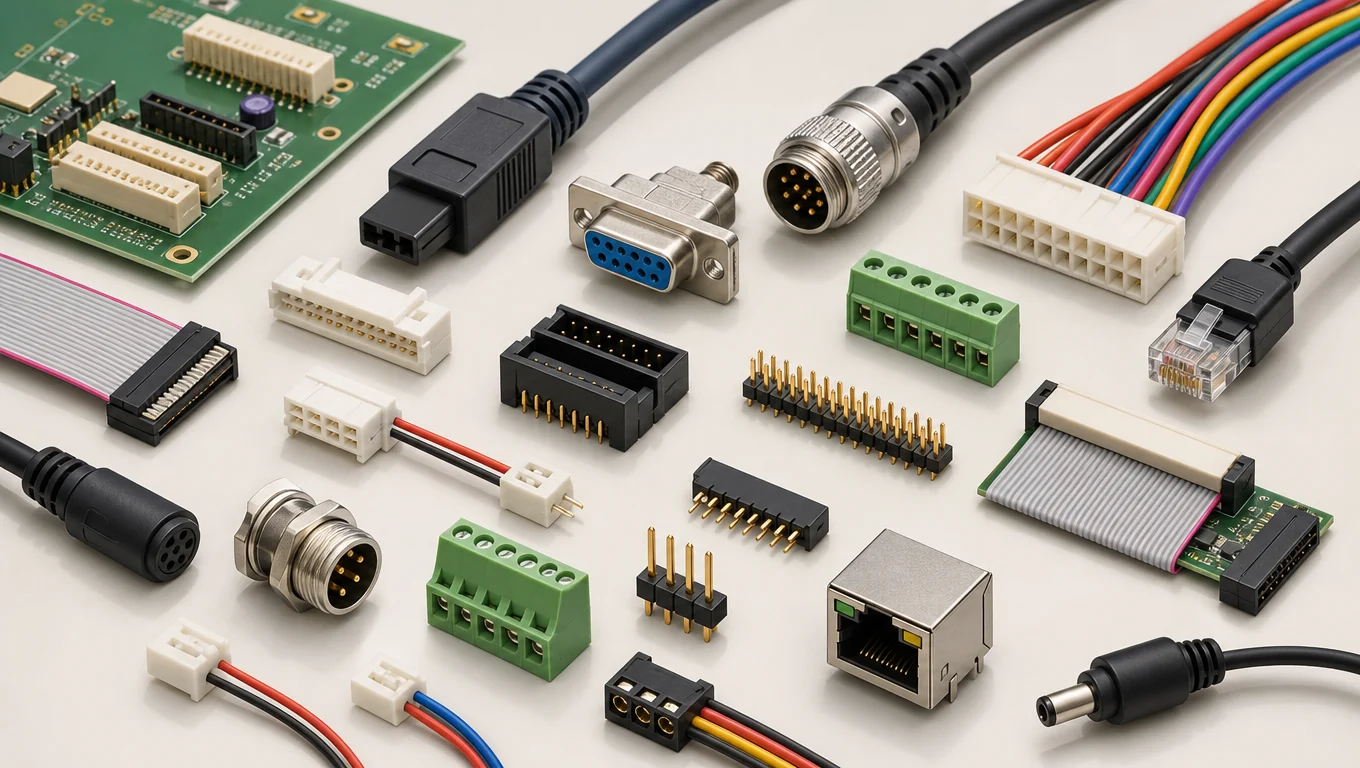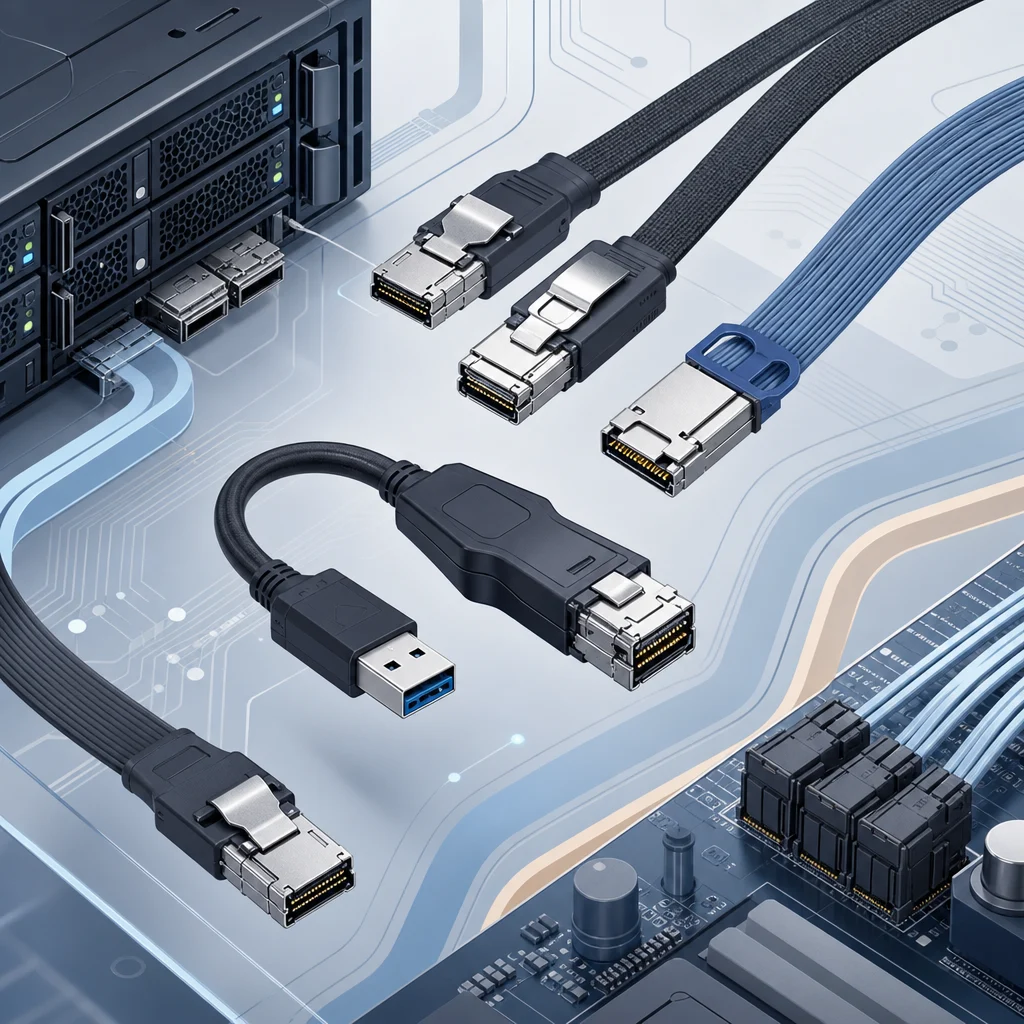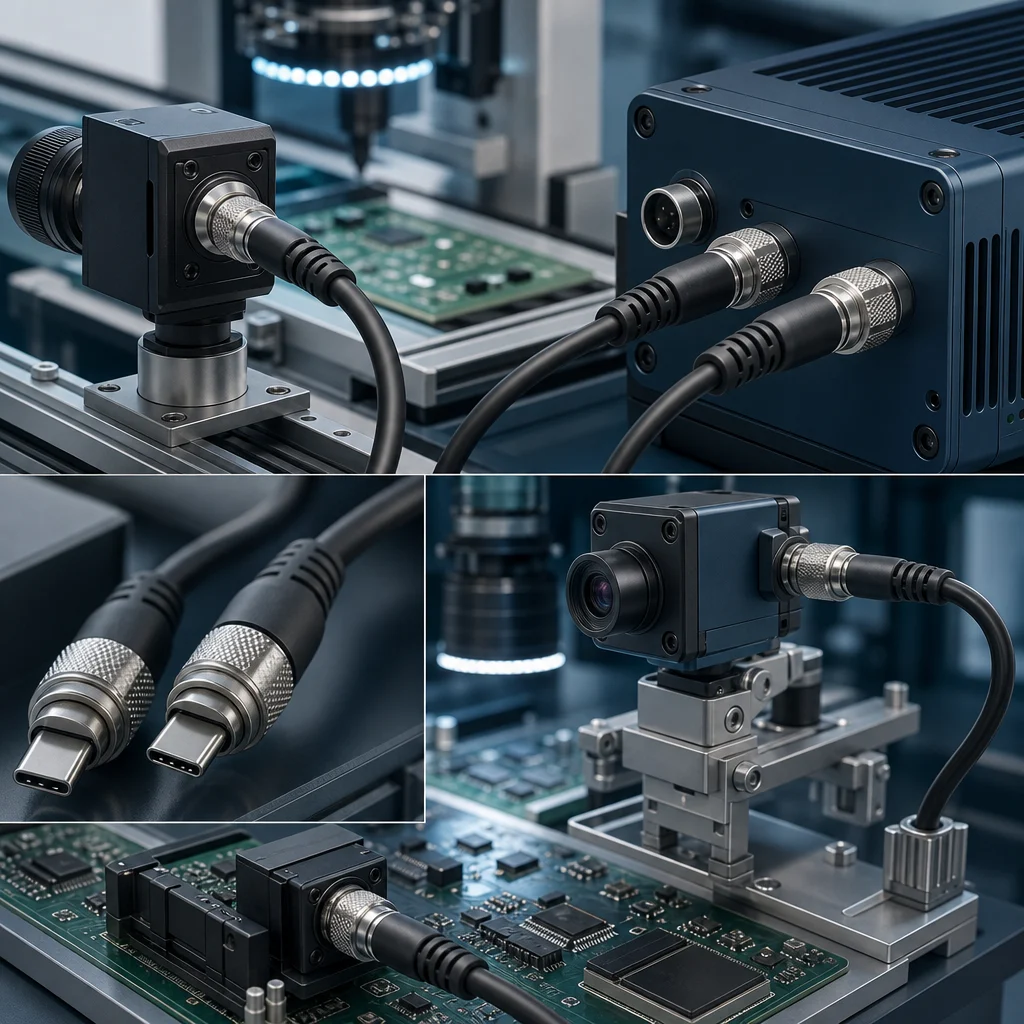
O USB-C rouba as manchetes, e com boa razão. Mas se você entrar em uma fábrica, um quarto de equipamentos hospitalares ou um depósito de serviços de campo, a população de conectores parece muito diferente. Controladores lógicos programáveis comissionados há uma década ainda apresentam portas de serviço Mini-USB. Scanners portáteis, câmeras mais antigas, unidades GPS e uma longa cauda de instrumentos de medição ainda são distribuídos ou distribuídos com Micro-USB. As máquinas mais novas no mesmo piso executam USB-C. Alguém precisa manter todos os três vivos, e essa pessoa geralmente é a que escreve a especificação do cabo.
Este guia é escrito para essa pessoa. Ele compara o Mini USB, o Micro USB e o USB-C nos atributos que decidem uma decisão de compra — retenção mecânica, capacidade de dados, capacidade de alimentação e o que acontece quando o ambiente se torna hostil — e usa figuras publicadas na documentação técnica própria do fabricante, em vez de marketing genérico.
Por que os Conectores Legados Ainda São um Problema de Engenharia
O instinto ao enfrentar um patrimônio misto de conectores é padronizar o USB-C e ficar pronto. Na prática, isso raramente é possível em uma única etapa, e a razão não é o conservadorismo. É que o conector faz parte de uma montagem certificada. Mudar a porta de serviço de um dispositivo médico ou de uma peça de equipamento industrial pode acionar a retestagem de toda a unidade, não apenas da porta. O cabo é barato; a recertificação não é.
O resultado é um longo período de sobreposição onde três gerações de conectores coexistem no mesmo local. Essa sobreposição é gerenciável se estiver planejada. Ela se torna cara quando é descoberta, tipicamente de uma de duas maneiras: um engenheiro de campo chega com o cabo errado e o trabalho é reprogramado, ou um comprador encomenda “cabos USB” em massa e recebe montagens que são fisicamente corretas, mas eletricamente erradas para a aplicação.
O segundo tipo de falha é o mais insidioso, porque parece sucesso até ser instalado. Um cabo que se conecta perfeitamente ainda pode ser limitado a velocidades USB 2.0 e carga lenta, e a orientação técnica publicada sobre esse ponto é direta: dois cabos podem parecer idênticos, enquanto seu cabeamento interno difere completamente. Alguns suportam apenas 480 Mbps e carga lenta; outros são montagens totalmente funcionais, carregando vídeo 4K, dados de 10 Gbps e carga de 100 W na mesma bainha.
As Três Famílias de Conectores, e de Onde Cada Uma Vem
Compreender a genealogia ajuda a prever o comportamento no campo.
As famílias Mini e Micro pertencem à era do USB 2.0. O USB 2.0 foi lançado em 2000 e ofereceu uma taxa de transferência High-Speed de 480 Mbps, mais de quarenta vezes mais rápido que seu antecessor, com fornecimento de energia de até 2,5 W. Isso foi suficiente para tornar drives externos, webcams e scanners genuinamente práticos, e estabeleceu a população de conectores ainda em uso hoje: o retangular plano USB-A para dispositivos maiores como impressoras, e os conectores menores para equipamentos portáteis. Em orientações aplicadas publicadas, cabos USB mini são associados a dispositivos que requerem um conector menor, como câmeras mais antigas e unidades GPS, enquanto cabos USB micro são associados a dispositivos menores, como smartphones e tablets.
O próximo grande avanço veio com o USB 3.0, introduzido em 2008 e posteriormente rebatizado de USB 3.1 Gen 1, que trouxe o protocolo SuperSpeed com um máximo teórico de 5 Gbps. Isso foi conseguido adicionando fios internos para permitir comunicação full-duplex, e as portas eram tipicamente coloridas em azul para distingui-las. Crucialmente, o USB-A foi projetado para ser compatível com versões anteriores, o que é a razão pela qual a transição do ecossistema foi tão suave.
O USB-C é o ponto final atual dessa linha. É um sistema de conector físico construído em torno de um design reversível de 24 pinos em ambas as laterais, o que o torna reversível — não há cima ou baixo. Documentação de produtos publicados observa que é aproximadamente do tamanho do plugue Micro-USB mais antigo, sendo porém muito mais capaz, e que uma única montagem de alta qualidade pode transportar dados, energia e vídeo simultaneamente.
Tabela de Comparação: USB Mini vs USB Micro vs USB-C
A tabela abaixo compara as três famílias com base nos critérios que determinam uma compra. As células que dependem da montagem específica em vez da família de conector são marcadas como dependentes da montagem, pois é ali que a maioria dos erros de fornecimento ocorre.
| Critério | USB Mini | USB Micro | USB-C |
|---|---|---|---|
| Era e padrão de origem | Era do USB 2.0 | Era do USB 2.0 | Geração atual, 24 pinos em ambas as laterais |
| Orientação | Direcional | Direcional | Reversível, não há cima ou baixo |
| Tamanho relativo | Menor que o USB-A | Menor que o USB-A; o USB-C é aproximadamente deste tamanho | Fino, oval |
| Dispositivos host típicos | Câmeras antigas, unidades GPS, portas de serviço legadas | Smartphones, tablets, dispositivos portáteis menores | Novos laptops, câmeras industriais, sistemas de visão computacional |
| Capacidade de dados | Depende da montagem; montagens da classe USB 2.0 operam a 480 Mbps | Depende da montagem; montagens da classe USB 2.0 operam a 480 Mbps | Depende da montagem; documentado até 10 Gbps ou 20 Gbps em montagens capazes |
| Capacidade de energia | Nível legado, consistente com o perfil de 2,5 W do USB 2.0 | Nível legado | USB Power Delivery até 100 W, e até 240 W com o padrão EPR mais recente |
| Saída de vídeo | Não aplicável | Não aplicável | Sim em montagens capazes; vídeo 4K documentado |
| Retenção sob vibração | Apenas atrito; uma fraqueza conhecida em equipamentos em movimento | Apenas atrito | Apenas atrito, a menos que uma variante com trava seja especificada |
| Status de fornecimento | Legado; planeje para obsolescência | Legado; ainda amplamente em estoque | Padrão atual para novos projetos |
O Que Realmente Quebra em Campo
Connector failures in industrial environments cluster into three patterns, and they are rarely about the cable breaking cleanly in half.
The first is retention. A friction-fit connector in a vibrating cabinet walks out over time. Published guidance on industrial USB-C is explicit that standard connectors can vibrate loose in factory settings, and that the mitigation is a locking design: connectors with single or dual screw locks on the housing, which bolt securely into the port and hold a stable connection for industrial cameras and machine vision systems even under intense vibration. If your equipment moves, this is not an optional upgrade.
The second is electrical mismatch. The connector mates, the device charges slowly or enumerates at the wrong speed, and nobody can see the problem because the physical layer looks fine. This is the failure mode behind the warning that a low-quality cable on a high-end device will bottleneck its performance. The specification fix is to state the required data rate and power level on the purchase order and require the supplier to confirm the assembly meets it, rather than ordering by connector shape.
The third is contamination and mechanical wear at the port. Legacy connectors on older equipment have often been mated hundreds of times by staff who were not thinking about connector life. By the time a replacement cable is ordered, the port on the device may be the real problem. A good diagnostic routine checks the device port before blaming the cable, and a good supplier will ask about the port condition rather than simply shipping a replacement.
A structured approach to these failure patterns, including how to isolate whether the fault sits in the cable, the connector or the port, is set out in the diagnostic guide to common cable failures.
Matching Power and Data to the Application
The numbers that matter are not the headline maximums. They are the values your device actually needs, stated clearly enough that a supplier can confirm or decline them.
On power, the scale runs from the legacy USB 2.0 profile of up to 2.5 W, through the typical 2.5 W to 5 W output of a standard USB-A port, to USB Power Delivery on USB-C at up to 100 W, and up to 240 W under the latest EPR standard. A single USB-C assembly at the high end can charge a phone, a tablet and a powerful laptop. If your application is a handheld scanner that trickle-charges overnight, specifying a 100 W assembly is waste without benefit; if it is an industrial camera drawing real power over the same cable, underspecifying is a field failure waiting to happen.
On data, the practical ladder runs 480 Mbps for USB 2.0 class work, 5 Gbps for SuperSpeed, and 10 or 20 Gbps on capable USB-C assemblies. Transferring configuration files to a legacy controller needs the first rung. Streaming uncompressed video from a machine vision camera does not. The mistake is assuming the connector implies the speed — it does not, and the documented example is stark: some USB-C cables support only USB 2.0 speeds and slow charging while others are full-featured.
There is a compliance dimension here too. A poorly made USB-C cable can draw too much power and damage the device it is connected to, which turns a five-dollar saving into a four-figure replacement. Certifications to look for on the supplier side include ISO 9001 and ISO 14001 for the manufacturing system, and CE and FCC compliance for the product.
Four Realistic Migration Paths
Once the estate is mapped, migration usually resolves into one of four patterns.
- Adapter bridging. The fastest fix for a mixed estate, connecting an existing USB-A or legacy device to a newer USB-C port. It solves today’s problem and adds a mechanical joint, so it suits bench and service environments rather than permanently vibrating installations.
- Hybrid assemblies. A single cable with a legacy connector at one end and USB-C at the other, built to a defined specification. This removes the adapter from the chain and is usually the right answer for equipment that is being kept but re-cabled.
- Locking USB-C retrofit. Where the device already has USB-C but the environment is hostile, moving to a screw-locking assembly addresses the retention failure without touching the device certification. This is the common pattern for industrial cameras and machine vision.
- Full redesign. Appropriate at end-of-life or when the device is being re-certified anyway. It is the most expensive path and the only one that removes the legacy connector from the bill of materials entirely.
The sequencing matters more than the choice. Standardising new purchases on USB-C while keeping a documented stock of legacy assemblies for installed base is usually cheaper than any forced conversion, and it avoids the trap of re-certifying equipment purely to retire a port.
Sourcing Checks Before You Commit
Five questions, asked before the purchase order, prevent most of the problems described above.
First: what data rate and power level must the assembly actually carry? Get it in writing on the order. Second: is a locking variant required? If the equipment vibrates, friction retention is not sufficient. Third: which certifications apply to your market and does the supplier hold them — ISO 9001 and ISO 14001 for the manufacturing system, CE and FCC for the product. Fourth: is the assembly full-featured or charge-only? The connector shape will not tell you. Fifth: what is the plan for the legacy end of the estate, and is the supplier able to support both generations rather than only the current one?
Manufacturer track record is worth weighing alongside the specification. Longkai Electronics, which has been producing cable assemblies since 2012 and supplies consumer and industrial customers including LG and CATL, publishes ISO 9001 and ISO 14001 certification and CE and FCC product compliance, with over 100 global partners — the kind of documentation that makes the certification answers quick and verifiable rather than promotional.
For the underlying standards background, the evolution of USB from a simple port to a universal powerhouse traces how each generation solved the problems of its time, and the USB-C explainer covers the connector’s power, data and video capability in detail.
Perguntas Frequentes
Are Mini USB and Micro USB the same connector?
No. They are distinct connector families from the same USB 2.0 era, and they are not interchangeable. Published application guidance associates Mini USB with devices needing a smaller connector such as older cameras and GPS units, and Micro USB with smaller devices such as smartphones and tablets. Check the device port before ordering rather than assuming.
Can I replace a Mini USB cable with a USB-C cable?
Not directly, because the connectors are physically different. The practical options are an adapter, a hybrid assembly with a legacy connector at one end and USB-C at the other, or a device-side port change — and the third option can trigger re-certification of the whole unit.
Why does my USB-C cable charge slowly when the connector fits perfectly?
Because the connector shape does not determine capability. Documented guidance notes that two physically identical cables can differ internally, with some supporting only USB 2.0 speeds and slow charging while others are full-featured assemblies carrying 4K video, 10 Gbps data and 100 W charging. Specify the required rate and power level explicitly.
What should I specify for equipment that vibrates?
A locking connector. Standard USB connectors can vibrate loose in factory settings; screw-locking USB-C assemblies with single or dual screws on the housing bolt into the port and maintain a stable connection for industrial cameras and machine vision systems under intense vibration. Full design considerations are covered in the field engineer’s guide to screw-lock USB-C design.
How much power can USB-C actually deliver?
USB Power Delivery on USB-C reaches up to 100 W, and up to 240 W under the latest EPR standard. For comparison, standard USB-A ports typically output 2.5 W to 5 W, and the legacy USB 2.0 profile was up to 2.5 W. Match the rating to the device rather than defaulting to the maximum.
Planning the Overlap Rather Than Fighting It
The connector estate on a real site is an artefact of procurement history, not a design choice, and the goal is to manage it rather than to eliminate it on a schedule. Map what you have, state data and power requirements explicitly on every order, specify locking connectors wherever equipment moves, and standardise new purchases on USB-C while keeping documented legacy stock for the installed base.
That approach costs less than forced conversion and avoids re-certifying equipment just to retire a port. It also puts the specification in the right place: on the purchase order, where a supplier can confirm it or tell you it is not achievable, instead of in a complaint after the cable has been installed.