Промышленный USB-кабель выглядит идентично потребительскому, пока не выйдет из строя. В ячейке машинного зрения, шкафу ПЛК или гибочной цепи на роботизированной руке режимы отказа носят одновременно механический и электрический характер: коннектор выпадает под воздействием вибрации, оплетка расходится в месте отвода усилия, либо дифференциальная пара отклоняется от импеданса, и камера начинает терять кадры. Данное руководство объясняет, как специфицируются и создаются промышленные USB-кабели — классы фиксации, ограничения по скорости и длине, внутренняя конструкция и электрические тесты, которые отличают согласованную сборку от стандартной каталожной детали.
Потребительский и промышленный USB-кабель: что действительно меняется
Потребительский USB-кабель оптимизирован под стоимость в статичной среде с кондиционированием воздуха. Промышленный USB-кабель оптимизирован под фиксацию, экранирование и срок службы на изгиб. Имеют значение четыре различия:
| Свойство | Бытовой кабель | Промышленный кабель |
|---|---|---|
| Фиксация | Фрикционный запорный механизм, ~8–20 Н | Винтовая фиксация или защелка, 50–100 Н |
| Экранирование | Фольга только в некоторых вариантах | Фольга + оплетка, дренажный провод запаян к оболочке |
| Оболочка | PVC | PUR / TPE, сертифицировано для гибочных цепей |
| Отвод усилия | Двухкомпонентное формование | Одноголовое литое основание |
Типовые потребительские кабели также часто имеют недостаточную конструкцию: сторонние тесты регулярно выявляют алюминий с медным покрытием вместо чистой меди, слабую фиксацию отвода усилия и изоляцию, которая трескается в процессе эксплуатации, — все это увеличивает сопротивление проводника и приводит к прерывистым отказам (данные инспекции V-Trust).
Классы фиксации: фрикционный запор, винтовая фиксация и IP67
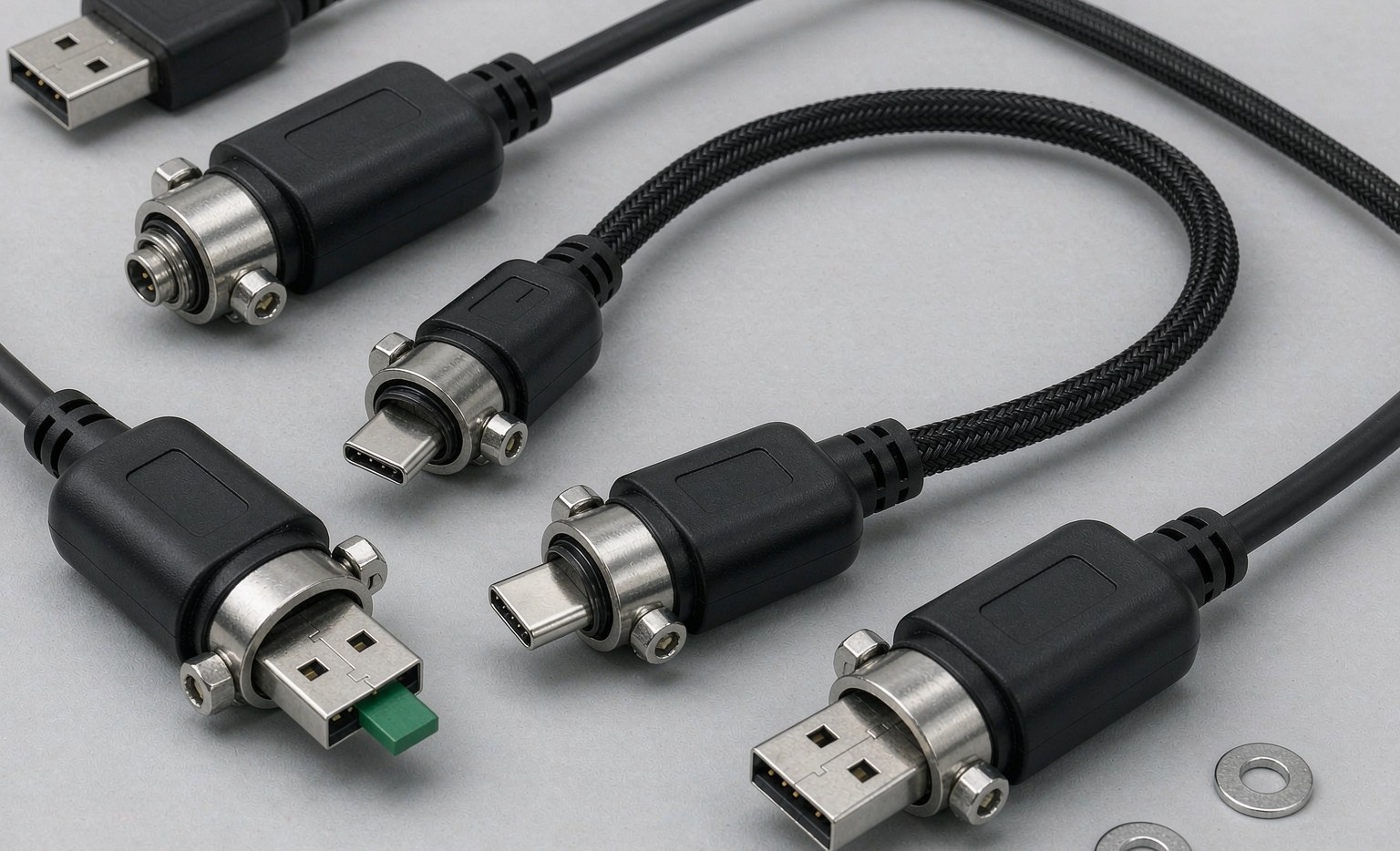
Фиксация — это спецификация, которую чаще всего игнорируют, и именно она быстрее всего останавливает линию. Для промышленного USB-кабеля фиксация измеряется как осевая сила, необходимая для разъединения вилки, и класс фиксации должен выбираться исходя из условий среды, а не из габаритов коннектора (Классификация фиксации TeleWire):
| Класс | Механизм | Сила фиксации | Загрязнение | Типичное применение |
|---|---|---|---|---|
| Потребительский | Внутренний фрикционный запорный механизм | ~8–20 Н | IP20 | Офис, лабораторный стол |
| Промышленная защелка | Внешняя металлическая втулка | ~25–30 Н | IP20 | Стационарный серверный стеллаж |
| Одинарная винтовая фиксация | 1 × M2 винт | ~50 Н | IP20 | Лёгкая автоматизация |
| Двойная винтовая фиксация | 2 × M2 винта | ~80 Н | IP20 | Машинное зрение, робототехника |
| Резьбовое соединение | Кольцевая втулка | ~100 Н | IP67/68 | ЧПУ, мойка, наружные условия |
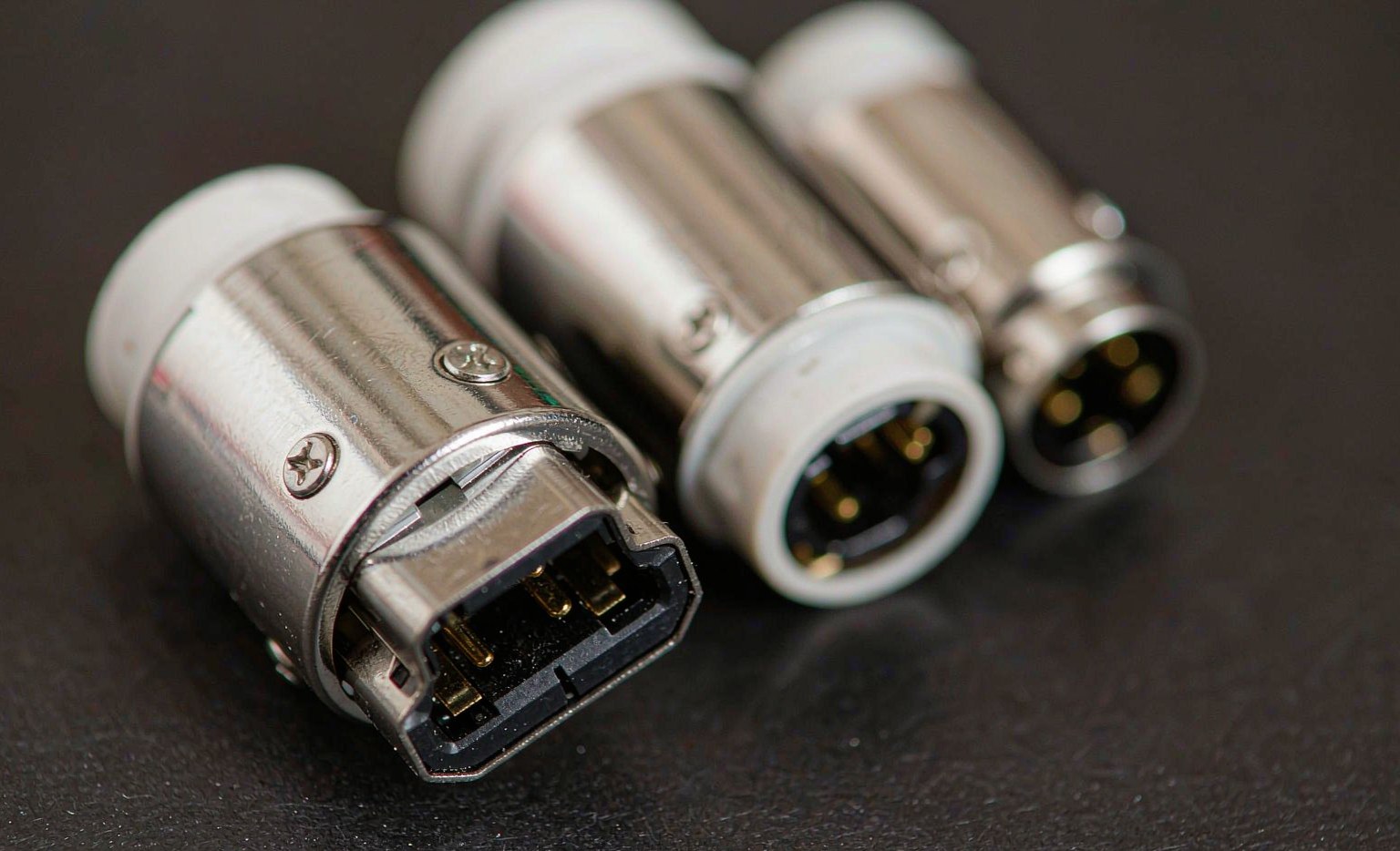
Одно практическое замечание: кабель с двойной винтовой фиксацией обеспечивает заявленную фиксацию только при наличии соответствующих резьбовых втулок в порту хоста. Без них винты вращаются свободно, и кабель ведёт себя как стандартная вилка — коннектор по-прежнему работает электрически, но преимущество фиксации теряется. USB-C и сборки USB 3.0 с винтовой фиксацией являются стандартными каталожными позициями в нашем линейке фиксаторов USB-кабелей, например USB 3.1 Type-C с винтами и USB 3.0 A-to-B with screws.
Speed versus passive length: the limit is physics
Higher signalling rates attenuate faster in copper, so the maximum passive length falls as the data rate rises. Exceeding these limits causes signal loss, link retraining and dropped frames, not merely slower transfers — the limits are engineering constraints rather than recommendations (Newnex):
| Standard | Скорость передачи данных | Max passive length | Typical application |
|---|---|---|---|
| USB 1.1 | 12 Mbps | ≤ 3 m | Legacy HID, control |
| USB 2.0 High-Speed | 480 Мбит/с | ≤ 5 m | 1080p cameras, PLC programming |
| USB 3.2 Gen 1 | 5 Гбит/с | ≤ 3 m | Machine-vision cameras |
| USB 3.2 Gen 2 | 10 Гбит/с | ≤ 1–3 m | 4K/8K industrial cameras |
| USB4 / Thunderbolt | 40 Гбит/с | ≤ 0.8–1 m | High-end vision, single-cable docks |
Beyond the passive limit the options are active extension (a repeater in the plug), an extender over Cat5e/Cat6, or an active optical cable. Active optical solutions remove EMI sensitivity over 30–100 m runs, but they cannot carry substantial USB Power Delivery, so a camera that relies on bus power needs a separate supply.
Inside the cable: construction decides signal integrity
A USB 2.0 High-Speed cable is not a bundle of wires. The USB specification defines the construction in detail: a non-twisted power pair of 28–20 AWG, one 28 AWG twisted data pair with an aluminium-metallised polyester inner shield, a 28 AWG stranded tinned-copper drain wire, and an outer braid of more than 65% coverage (construction reference). The twist ratio matters as much as the gauge: the specification calls for one full twist every 60–80 mm, and deviations measurably raise common-mode interference.
| Element | Спецификация | Why it matters |
|---|---|---|
| Power pair | 28–20 AWG, stranded tinned copper | Sets voltage drop and IR loss at load |
| Data pair | 28 AWG, twisted 60–80 mm pitch | Differential balance, common-mode rejection |
| Inner shield | Al/PET foil, metallised face outward | Must contact the drain wire to work |
| Outer shield | Tinned-copper braid, >65% coverage | EMI immunity near VFDs and servos |
| Tensile member | Nylon / Kevlar yarn | Prevents jacket fracture under pull |
Shielding is only effective if it is grounded. The braid and foil must terminate to the connector shell or a drain wire; a shield that is not bonded to the device ground behaves as an antenna rather than a barrier.
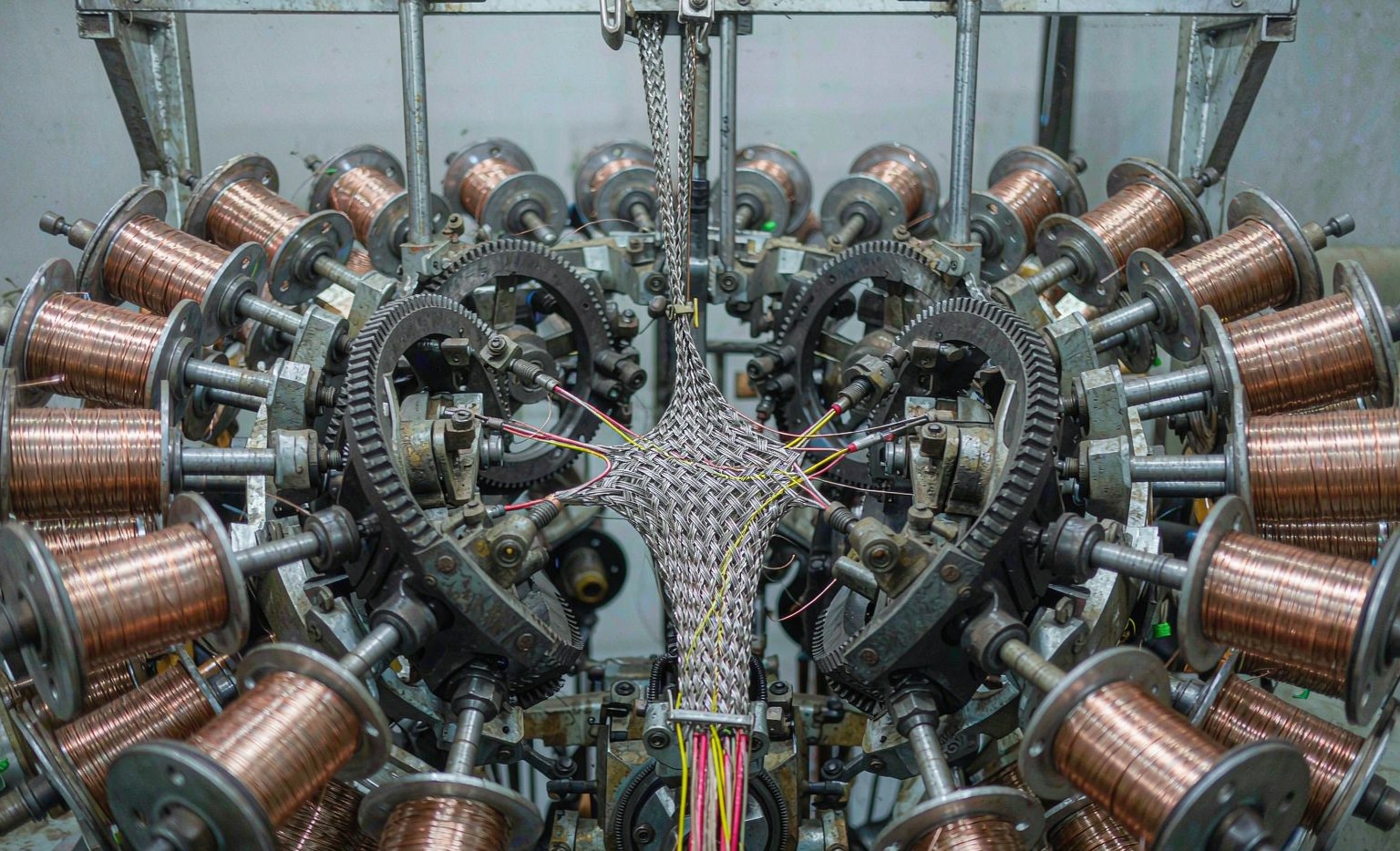
How an industrial USB cable is manufactured
- Wire drawing and stranding — high-purity copper rod is drawn through successive dies and stranded so the conductor stays flexible.
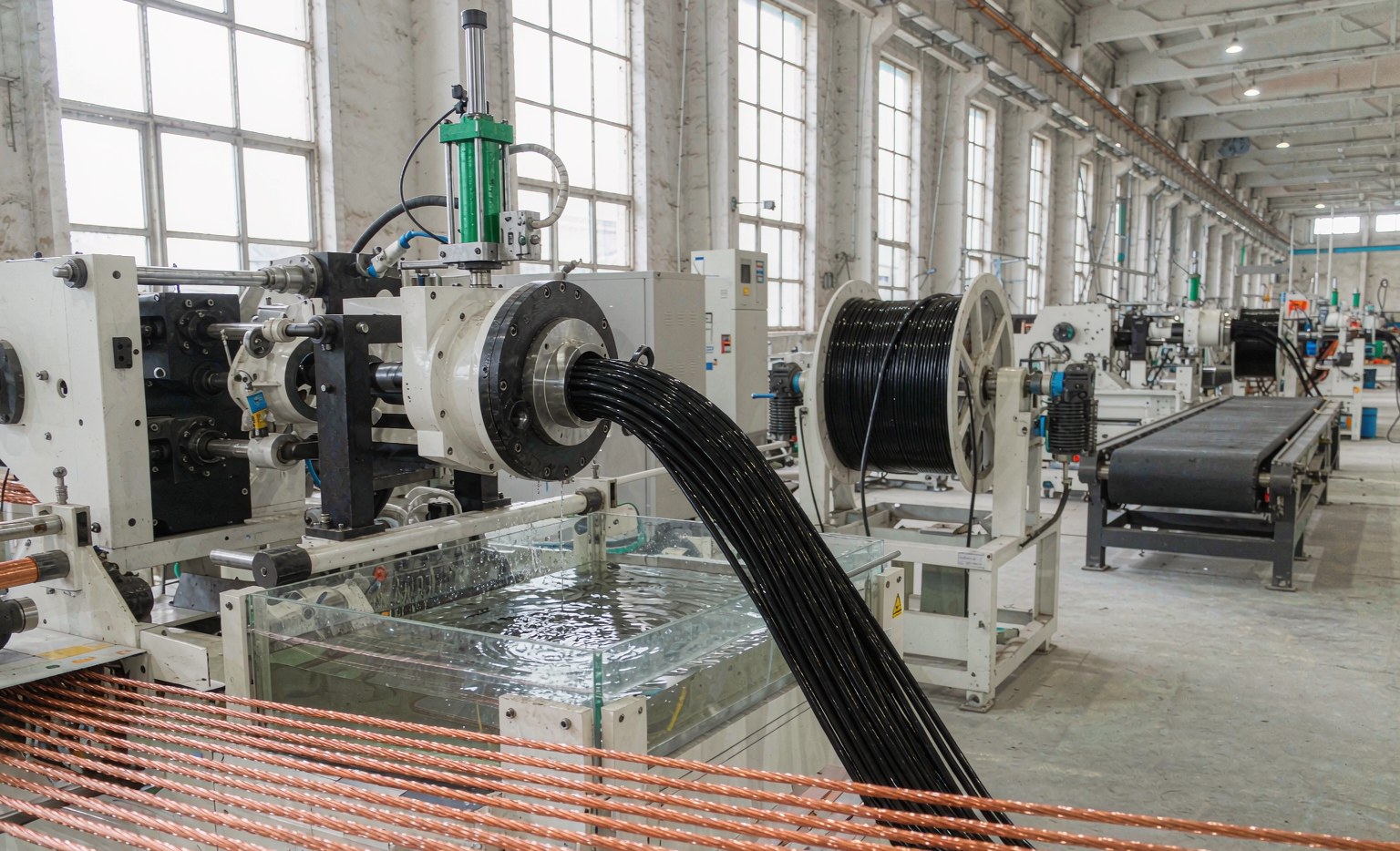
- Insulation extrusion — the conductor is coated with PE/HDPE. Extrusion temperature and line speed set insulation concentricity, which in turn sets impedance stability.
- Pair twisting — differential conductors are twisted at a constant pitch on a precision machine.
- Cabling and shielding — cores, drain wires and fillers are laid up, then foil-wrapped and braided.
- Jacket extrusion — the outer PUR/TPE or PVC sheath is applied.
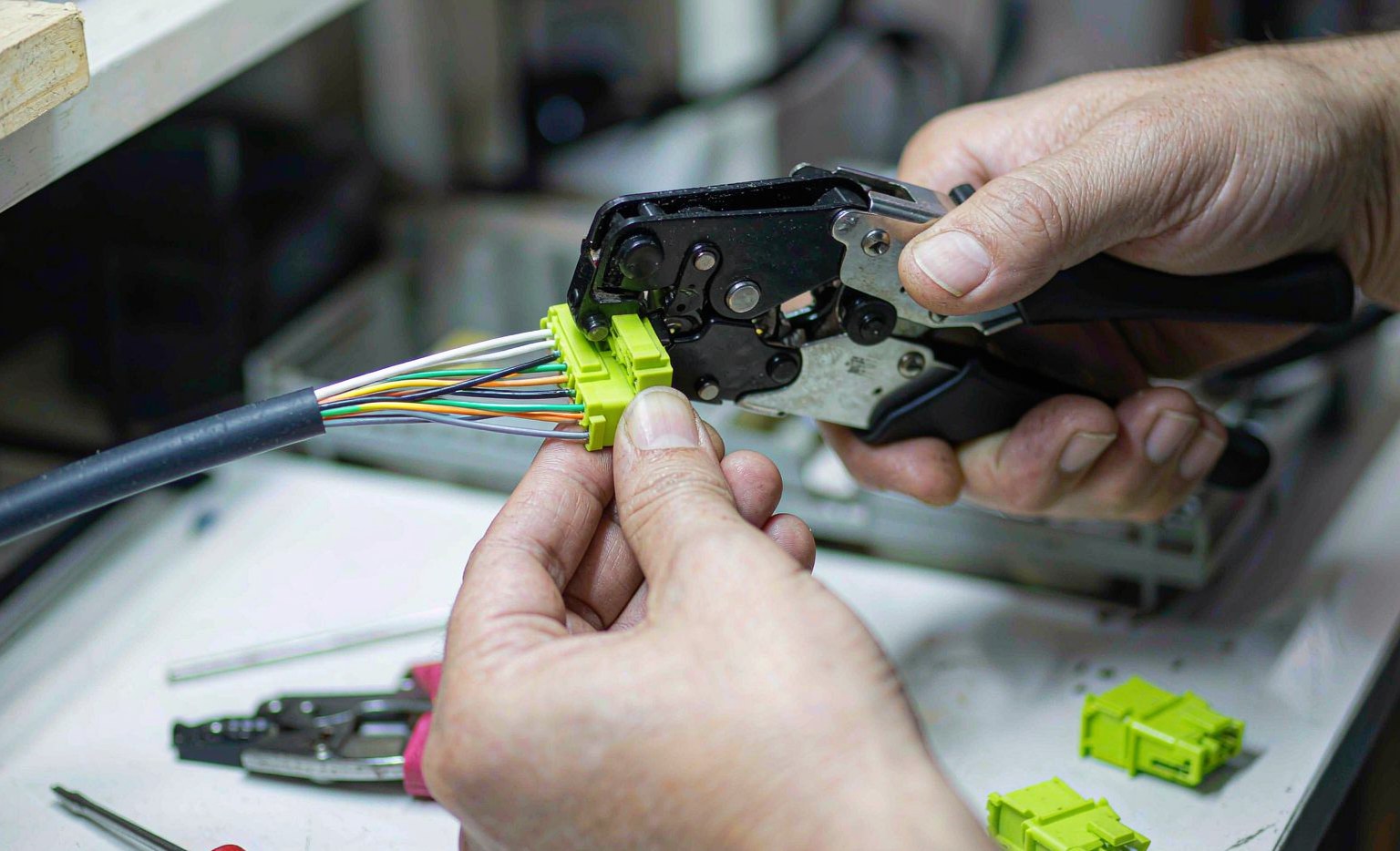
- Cutting, stripping and termination — conductors are exposed and crimped or soldered into the connector; crimp quality directly determines contact resistance.
- Injection moulding — an over-moulded boot is formed at the connector-to-cable junction, the single most important feature for strain relief. USB-C assemblies that require an E-Marker must have the programmed chip soldered before this step.
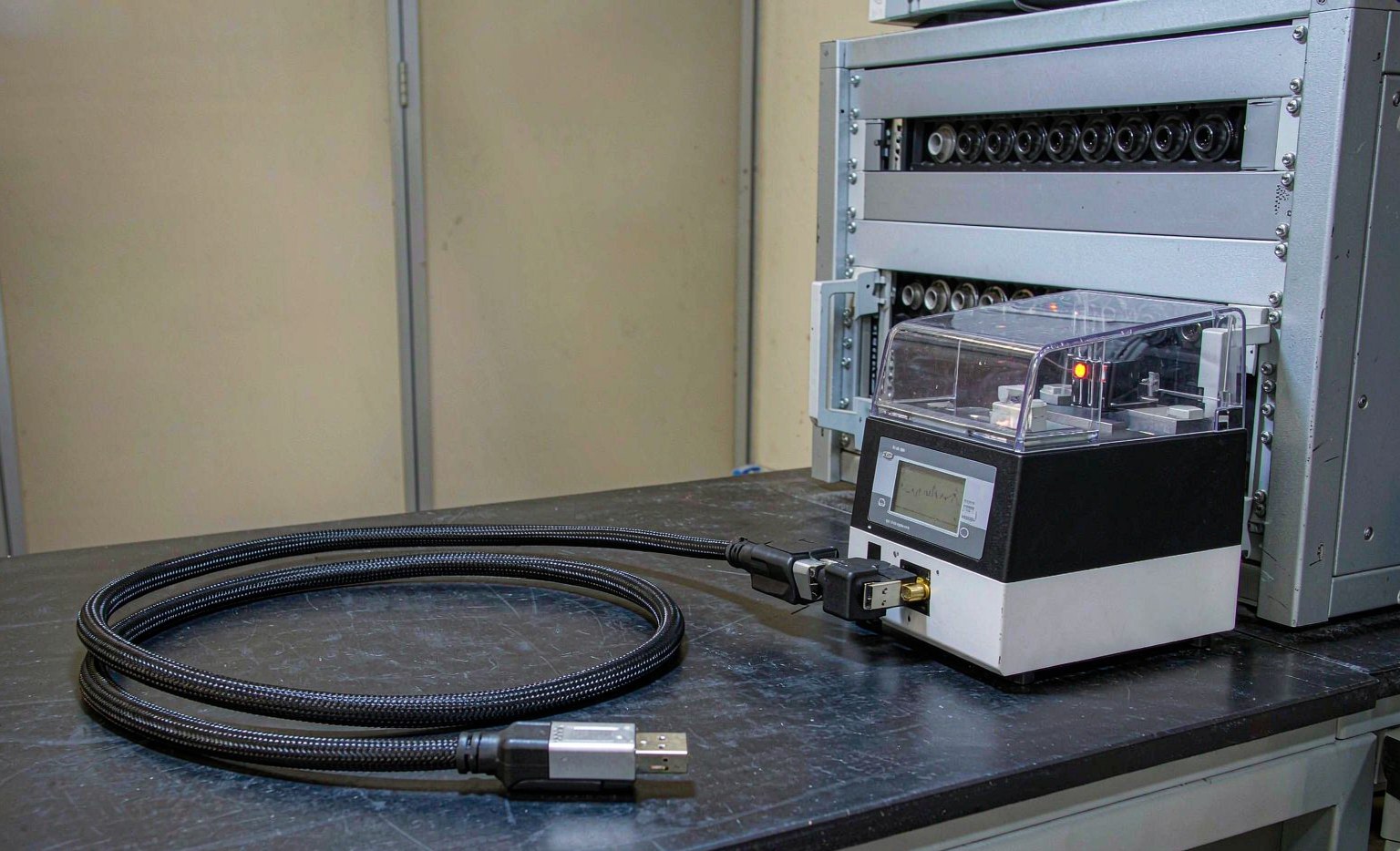
- 100% final test — every finished cable, not a sample, is electrically verified.
What a “100% tested” cable is actually tested for
| Test | What it catches |
|---|---|
| Continuity / wiring | Opens, shorts, swapped or misaligned pins |
| DC resistance | Undersized or non-copper conductors, high crimp resistance |
| High-voltage insulation (hi-pot) | Insulation breakdown between conductors and shield |
| Impedance / insertion loss (TDR) | Impedance mismatch, reflections, out-of-spec high-speed performance |
| E-Marker read-back | Wrong or counterfeit chip, incorrect current/voltage rating |
| Flex and insertion/extraction force | Strand fatigue, retention below specification |
For high-speed assemblies, impedance is the headline number. A 12 Gbps internal MiniSAS cable, for example, is specified at 100 Ω differential impedance; maintaining a tolerance as tight as ±5.2 Ω is what prevents signal reflection — the same discipline that a compliant industrial USB 3.x assembly needs (SFF-8643 vs SFF-8087 technical guide).
Standards and certifications to ask for
For a cable that will be installed in machinery, the relevant documentation is a combination of a signal standard and a safety/environmental standard set:
- Signal: USB-IF compliance for the speed grade claimed (USB Implementers Forum).
- Assembly workmanship: IPC/WHMA-A-620 for crimped and soldered cable assemblies.
- Electrical safety: IEC 62368-1 / EN 62368-1.
- Materials: RoHS and REACH; California Proposition 65 where the product ships to the US.
- EMC: FCC Part 15 and EN 55032 for the cable-plus-device system.
- Quality system: ISO 9001 (quality) and ISO 14001 (environment).
These are not interchangeable. A cable can pass continuity testing and still fail a hi-pot or an impedance check; conversely, a cable with excellent impedance control can fail RoHS on the jacket compound.
Specifying a custom cable: a six-point checklist
- Speed grade and length — state the protocol (USB 2.0 / 3.2 Gen 1 / Gen 2 / USB4) and the finished length; confirm it is inside the passive limit or specify active/optical.
- Retention class — match the retention force to the vibration environment, and confirm the host port has the threaded standoffs a screw-lock needs.
- Jacket and flex life — PUR or TPE for oil, abrasion and drag-chain duty; ask for the flex-cycle rating, because retention and flex life are different properties.
- Connector configuration — straight or right-angle over-mould, panel-mount feedthrough, or an M12 X-coded to USB adapter for sealed cabinets.
- Electrical targets — conductor gauge, differential impedance and tolerance, and the maximum permissible DC resistance.
- Certification and traceability — product certifications plus a per-batch test record, not just a catalogue claim.
Frequently asked questions
Can I use a screw-lock USB-C cable in a normal USB-C port?
Yes, it will plug in and work electrically. The screws only add retention if the host has matching threaded standoffs; otherwise they simply turn. For a laptop or hub without standoffs, choose a latching variant instead.
Why does my USB 3.0 camera cable work at 1 m but fail at 5 m?
Almost always cable length versus speed grade. Passive USB 3.2 Gen 1 copper is limited to roughly 3 m; beyond that, attenuation and impedance mismatch cause errors rather than a graceful slowdown. Use an active extension or a fibre/Cat extender.
What is the difference between an internal MiniSAS cable and an industrial USB cable?
Both are impedance-controlled shielded assemblies, but they serve different links. MiniSAS/SFF-8643 links storage inside a chassis; industrial USB links cameras, PLCs and instruments, and adds retention hardware that an internal cable does not need.
Do I need an E-Marker for a USB-C cable?
For USB-C cables rated above 3 A or supporting higher-speed data, yes. The E-Marker identifies the cable’s current and data capability to both ends; a missing or incorrect marker can limit charging or cause devices to negotiate unsafely.
Working with a cable manufacturer
Dongguan Longkai Electronics has manufactured high-speed data cables and connectors since 2012, operating a 3,000 m² facility with automated extrusion, braiding and assembly lines and an ISO 9001 / ISO 14001 quality system. Beyond catalogue items we build to drawing — custom lengths, panel-mount feedthrough assemblies and locking variants — with every assembly electrically tested before shipment. Browse the industrial cable range, the cable assembly range, or contact our engineering team with your specification.
Last updated: September 2026. Specifications follow the published USB-IF, IEC and IPC/WHMA-A-620 requirements; always confirm the passive length limit against the exact speed grade and cable construction of your assembly.