A cable is the cheapest component in almost every system it connects, and it is blamed for a disproportionate share of the failures. Intermittent disconnects, a monitor that will not wake, a laptop that charges at 60 W instead of 240 W, a server link that negotiates down to 6 Gb/s — in the field these all look like device faults, and a surprising number of them are cable faults.
The reason is that a modern high-speed cable is not a passive piece of copper. It is an active participant in a negotiation. The source device asks what the cable can carry, the cable answers, and the whole system then limits itself to the lowest common denominator. If the answer is wrong, missing or unverifiable, performance degrades silently — no error message, just a link that underperforms for years.
This article unpacks how cable ratings are actually established, what an E-Marker chip does, and which numbers on a specification sheet matter when you are buying at volume. All specifications quoted here are taken from products currently in production at our Dongguan facility.
The Four Numbers That Define a Cable
Most procurement conversations start with length and connector type. Both matter, but neither determines whether the cable will perform. Four other numbers do.
Data rate. Our LK-07 USB 4 Type-C Male Data Cable is specified at 40 Gbps. Our LUNGKAY USB 3.1 Type-C with screws cable is specified at 10 Gbps. Those are not marketing round numbers — they are the rate the conductor geometry, shielding and connector wiring are built to sustain, and the system will not exceed them.
Power delivery. The LK-07 supports 240 W at 48 V / 5 A and is backward compatible with 180 W, 140 W, 100 W and 60 W. The USB 3.1 locking cable is specified at 100 W. Power capability is a function of conductor cross-section and thermal behaviour, not of the connector shell.
Video capability. The LK-07 carries DP Alt Mode and supports a single 8K@60Hz display or dual 4K@60Hz, and is listed as supporting 8K, 5K at 60 Hz and 4K at 144 Hz. Video capability is a separate negotiation from data rate, which is why a cable can pass 40 Gbps of file transfer and still fail to light up a monitor.
Impedance. This is the number most often omitted from a buyer’s checklist and the one that quietly decides signal integrity at speed. Our Type-C to USB 3.1 USB-A female OTG cable lists impedance and capacitive reactance of 85Ω–100Ω. Our Mini SAS SFF-8087 internal cable lists a characteristic impedance of 100Ω ±10%. At 12 Gbps, a cable outside its impedance window does not stop working — it starts producing errors, and errors become retries, and retries become the mysterious throughput collapse that nobody can reproduce in the lab.
E-Marker Chips: The Cable’s Voice in the Negotiation
An E-Marker is a small chip embedded in the cable that identifies the cable to the device it is plugged into. It reports what the cable is rated to carry — current, voltage, and in some cases data capability — so the source can decide how much power to offer before it offers it.
This matters for one simple safety reason: a charger cannot know by looking at a plug whether the cable in between can handle 5 A. Without a reliable answer, the safe behaviour is to limit current. With a correct answer, the full negotiated power is released. Under the USB Type-C specification, cables intended to carry current above the base level are required to be electronically marked — and as with any specification, confirm the exact threshold and marking requirements against the current release of the standard and the certification program for your market.
You can see the pattern directly in our own catalog. Three separate products are specified with an E-Marker chip: the USB 4 Type-C charging cable at 240 W, the LK-07 data cable at 240 W, and the LUNGKAY USB 3.1 Type-C with screws cable at 100 W. The chip is not a premium feature reserved for the flagship product — it is present wherever the power level demands that the cable be able to identify itself.
Where a product carries a different function chip instead, the specification says so. Our USB 3.2 A male to Type-C female cable is described as equipped with a VL162 data chip and adhering to the USB 3.1 Gen2 standard at 10 Gbps. Different chip, different job: this is a protocol-side device, not a cable identification device.
For a buyer, the practical takeaway is straightforward. If your product needs to deliver high power, ask specifically whether the cable is electronically marked and what it reports. An unmarked cable in a 240 W application does not usually fail dramatically — it silently negotiates down, and the end user concludes that the charger is slow.
Reading a Real Electrical Specification
The fastest way to judge a supplier’s engineering depth is to ask for the electrical characteristics block and then read it properly. Here is what that looks like on our enterprise storage cables.
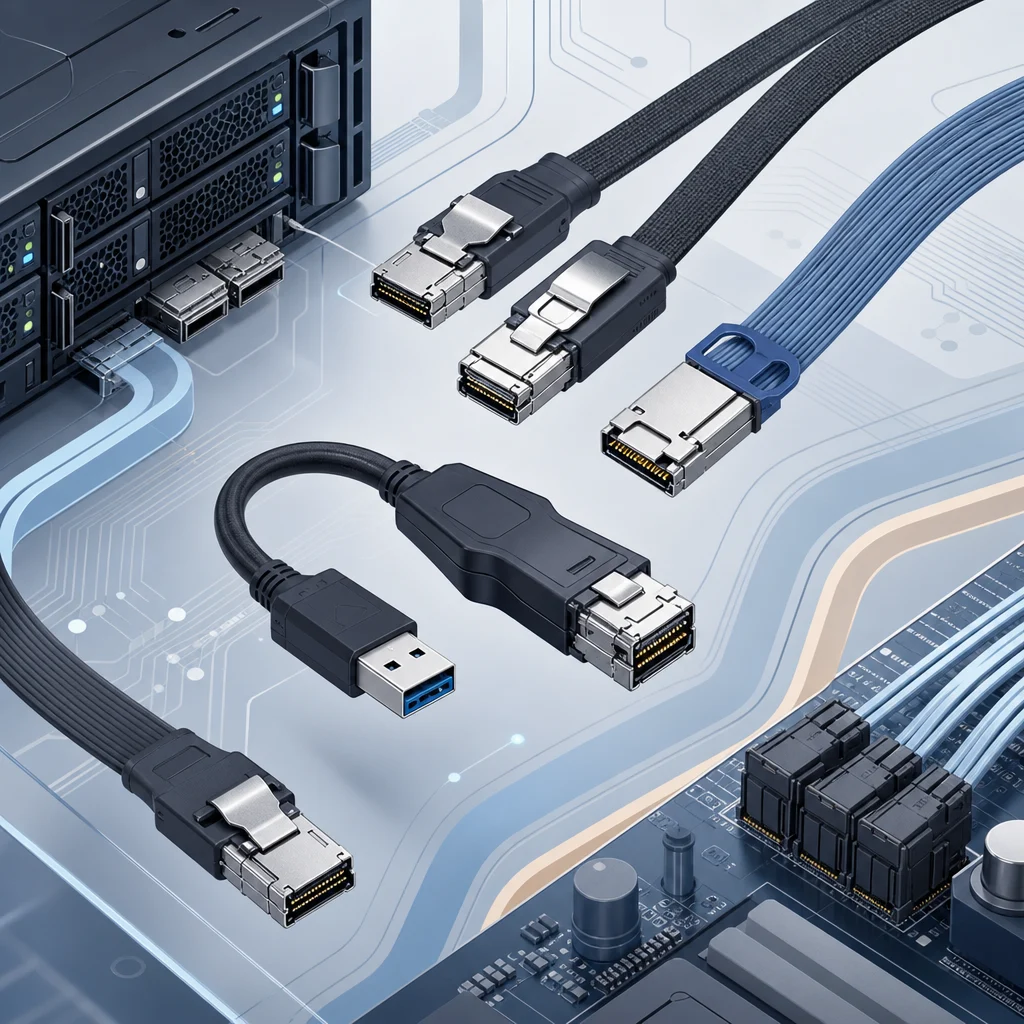
The Mini SAS SFF-8087 to 8087 cable is specified as: Interface Port A and B both SFF-8087 (Mini SAS Internal) 36-pin; length options 0.5 M, 0.8 M, 1 M and 2 M; support for SAS 3.0 (12 Gbps) with downward compatibility to SAS 2.0 (6 Gbps) and SAS 1.0 (3 Gbps); gold-plated stitches resistant to wear and oxidation; data speed 12 Gbps; rated voltage 30 V AC/DC; insulation resistance 100 MΩ; characteristic impedance 100Ω ±10%; high-frequency copper as the conductor; application backplane to HBA card connection, high-density server internal wiring and multi-disk cage cascading; RoHS compliant.
Our SFF-8644 to 8644 internal high-speed cable adds parameters that only appear when a supplier has actually characterised the product: insertion and ejection life of at least 1,000 cycles, and an operating temperature range of −20 °C to +80 °C, with dual-line configuration where each cable contains 4 channels for full-duplex data transmission.
Those last two lines are the ones worth watching for. Mating cycle life tells you whether a cable is built for a one-time install or for a serviceable rack. Operating temperature range tells you whether the jacket and insulation were selected for a data centre or for an outdoor enclosure. A supplier who cannot quote either is quoting from a catalog, not from a test report.
Jacket and Build: Nylon Braid Versus PVC
Jacket material is where the product meets the environment, and our range uses two different answers for two different jobs.
Our USB 4 cables are specified with a nylon braided appearance, with copper as the conductor material and colour options in black, gun colour, blue and grey. Braid resists abrasion from repeated coiling and dragging across a desk, and it is the finish consumers expect on a premium charge-and-display cable.
Our industrial USB 3.1 Type-C locking cable is specified with PVC material, described as resistant to scratches, abrasions, dirt and moisture, durable and tear-resistant without breaking. PVC is the right call here because this cable’s job is different: it is fixed to equipment with screws and left alone. It needs chemical resistance, a stable jacket that will not fray against a machine frame, and a surface that can be wiped down in a factory.
The screw design itself is the other half of that product’s specification. By fixing the cable mechanically to the device, it keeps the connection stable under vibration — the failure mode that a lab bench never reproduces and a factory floor reproduces constantly. The product’s listed application scope includes industrial cameras, which is exactly the environment where an unsecured connector works on day one and intermittently fails by month three.
Specification Comparison Across Real Products
The table below lists published specifications from five products currently in production. It is useful as a template for the comparison you should be building with any supplier.
| Product | Data rate | Power | Chip | Build / jacket | Notable electrical spec |
|---|---|---|---|---|---|
| LK-07 USB 4 Type-C Male Data Cable | 40 Gbps | 240 W, 48 V / 5 A | E-Marker chip | Nylon braided, copper | DP Alt Mode, single 8K@60Hz or dual 4K@60Hz |
| USB 4 Type-C Cable for Charging | 40 Gbps | 240 W | E-Marker chip | Nylon braided, copper | 8K high-definition screen projection |
| USB 3.1 Type-C with Screws Cable | 10 Gbps | 100 W | E-Marker chip | PVC, scratch / abrasion / dirt / moisture resistant | Screw-locking for industrial cameras |
| Type-C to USB 3.1 A Female OTG Cable | 20 Gbps | 240 W, 5 A | — | RoHS compliant | Impedance and capacitive reactance 85Ω–100Ω |
| Mini SAS SFF-8087 to 8087 | 12 Gbps (SAS 3.0) | — | — | Gold-plated contacts | 30 V AC/DC, 100 MΩ insulation, 100Ω ±10% |
| SFF-8644 to 8644 Internal | 12 Gbps (SAS-3) | — | — | Gold-plated contacts | ≥1,000 mating cycles, −20 °C to +80 °C |
Two observations. First, power rating and data rating move independently: the USB 4 cables carry both the highest data rate and the highest power, while the SAS cables carry high data rates at a rated voltage of only 30 V. Second, the enterprise cables publish environmental and mechanical data that consumer cables do not, because the buying decision in that channel is made on service life rather than on features.
A Procurement Checklist Before You Commit
Based on the specifications above, these are the questions worth answering in writing before an order is placed.
Ask for the full electrical characteristics block, not just the headline data rate. Rated voltage, insulation resistance, characteristic impedance with tolerance, and conductor material should all be quotable. If a supplier will not state impedance with a tolerance, they have not measured it.
Confirm the chip function. Ask whether the cable is electronically marked, what it reports, and whether the rating is supported by certification. For a 240 W product this is not a detail; it is the difference between a cable that delivers 240 W and one that delivers 60 W while looking identical.
Confirm mechanical life where it matters. For anything that will be plugged and unplugged repeatedly, ask for mating cycle data — our SFF-8644 cable is specified at 1,000 cycles or more. For anything installed once and forgotten, prioritise jacket chemistry and temperature range instead.
Confirm environmental compliance in writing. Our Mini SAS and OTG cables are listed as RoHS compliant, and compliance should appear as a named line in the specification, not as an assumption.
Confirm the length options you actually need. Our USB 4 cables are offered at 0.2 M, 0.5 M, 1 M and 2 M with customized lengths available, the SFF-8644 at 0.5 M, 0.8 M, 1 M, 2 M and 3 M, and the OTG adapter at 0.2 M through 2 M. Length is not cosmetic at high speed — a longer run has more loss, and the negotiated rate can change with it.
Finally, ask about OEM/ODM scope early. Every product referenced here is listed as OEM/ODM available, with customization covering cable length, wire gauge and connector type. Specifying these at the enquiry stage costs nothing; changing them after tooling is cut costs a lot.
Frequently Asked Questions
What does an E-Marker chip actually do?
It identifies the cable to the device it is connected to, reporting what the cable is rated to carry so that the source can safely negotiate power. Without a reliable answer, a charger defaults to a conservative current limit. In our range, the 240 W USB 4 data cable, the 240 W USB 4 charging cable and the 100 W USB 3.1 locking cable are all specified with an E-Marker chip.
Why does my 240 W charger only deliver 60 W?
In most cases because something in the chain — cable, port or device — cannot confirm it can carry the higher level, so the system negotiates down to a safe default. Check that the cable is electronically marked and rated for the power level you expect before suspecting the charger. Our USB 4 Type-C cables are specified at 240 W 48 V / 5 A and listed as backward compatible with 180 W, 140 W, 100 W and 60 W.
Is a nylon braided cable better than PVC?
They suit different applications. Nylon braid, used on our USB 4 cables, resists abrasion from daily handling and coiling. PVC, used on our industrial USB 3.1 Type-C locking cable, is specified as resistant to scratches, abrasions, dirt and moisture and is easier to wipe down in a factory. Choose by environment, not by appearance.
Which specifications matter most for server and storage cables?
Beyond data rate, look for characteristic impedance with tolerance, insulation resistance, rated voltage, contact plating, mating cycle life and operating temperature. Our SFF-8087 cable specifies 100Ω ±10% impedance, 100 MΩ insulation resistance and 30 V AC/DC; our SFF-8644 cable adds a mating life of at least 1,000 cycles and an operating range of −20 °C to +80 °C.
Can the length options be customized?
Yes. Lengths are already offered across a range — 0.2 M to 2 M on the USB 4 cables, up to 3 M on the SFF-8644 — and customized lengths are available on the LK-07. On OEM/ODM projects, cable length, wire gauge and connector type can all be specified, but they need to be defined before tooling.
Conclusion
Cable performance is decided long before the cable is plugged in. It is decided when the conductor is chosen, when the impedance is controlled, when the jacket is matched to the environment, and when the identification chip is programmed with a rating the cable can genuinely sustain. Everything the user experiences afterwards is just the system reading those decisions back.
For buyers, the discipline is simple: stop comparing cables on connector type and length, and start comparing them on the four numbers that govern behaviour — data rate, power, video capability and impedance — plus the environmental and mechanical data that predict service life. Ask for the electrical block, confirm the marking, and get the compliance line in writing.
Dongguan Longkai Electronics builds USB, Mini SAS and custom cable assemblies across consumer, industrial and enterprise channels, with OEM/ODM support on length, gauge and connector configuration. If you are specifying a cable and want the numbers rather than the adjectives, start from the product centre or read through the engineering breakdowns on our blog.