
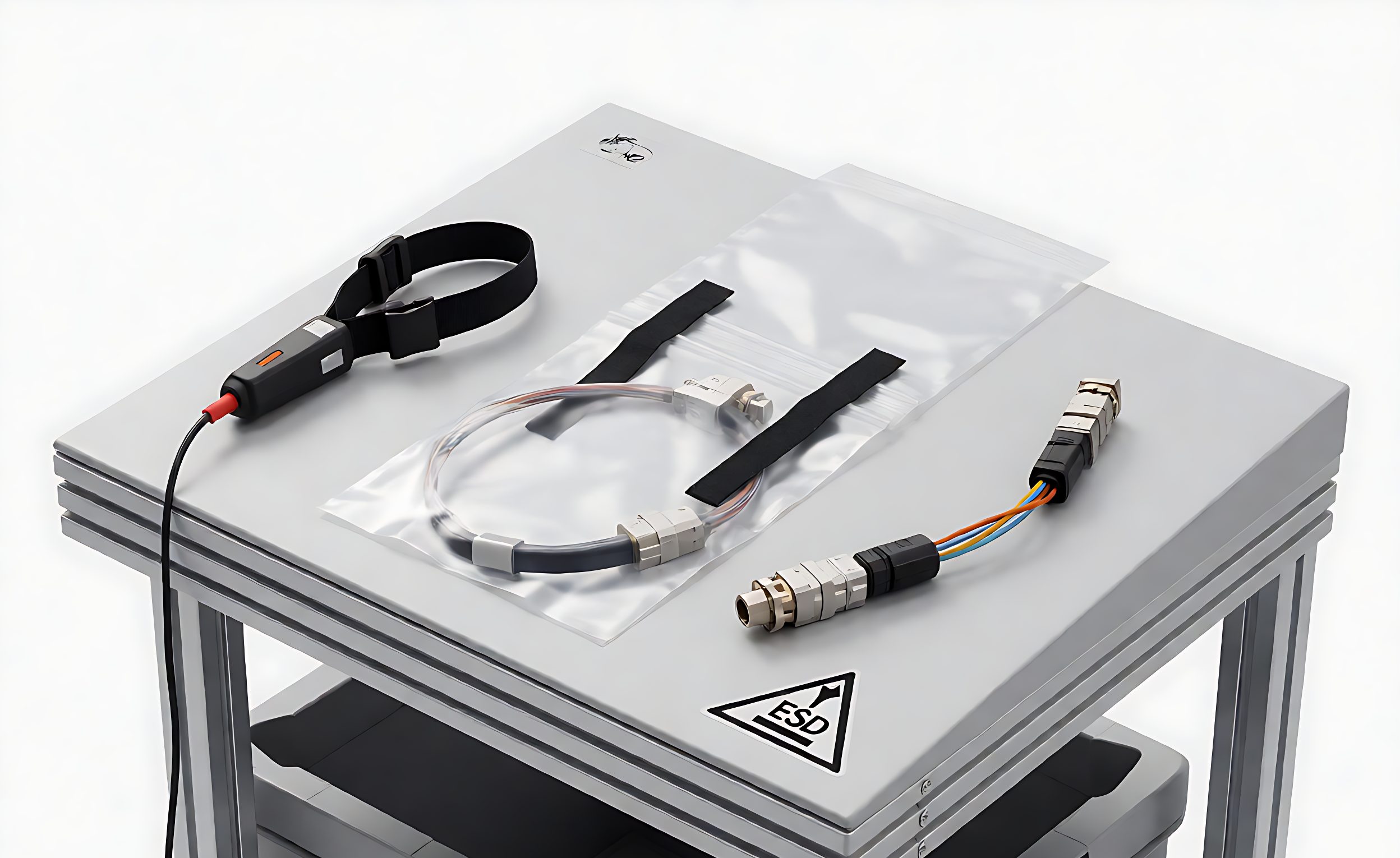
ESD-safe and cleanroom packaging are requested on cable assemblies more often than they are needed, and omitted more often than they should be. Both mistakes come from the same place: packaging is treated as a checkbox on a specification template rather than as a decision about what the assembly is about to be installed into. A cable going into a consumer product on a bench needs neither. A cable going into a semiconductor tool, an optical module or a sterile medical assembly may need both, and the consequences of getting it wrong are expensive and hard to trace.
The useful starting point is not the packaging at all but the destination: what the assembly touches during installation, what it sits next to once installed, and what level of contamination or discharge would cause a failure that nobody would attribute to the cable.
What ESD Damage Actually Looks Like
Electrostatic discharge damage is unpopular with engineers because it rarely presents cleanly. A cable assembly is largely passive: conductor, insulation, shield and connector shell. There is nothing in it to destroy with a spark in the way a semiconductor die can be destroyed. The risk instead sits at the edges, where a cable assembly carries something that is sensitive.
Three cases cover most real requirements. First, assemblies with active electronics inside them: an e-marker chip in a USB-C plug, a repeater or retimer in an active optical or high-speed copper assembly, a small identification device in a medical connector. These can be damaged by handling discharge exactly like any component, and they are the strongest reason to require ESD packaging. Second, assemblies whose connector contacts mate directly to a sensitive board: a charged cable can discharge into the equipment during installation, and the failure appears later as an intermittent fault in the host device. Third, assemblies installed in environments where a spark is itself unacceptable, such as around flammable atmospheres or explosives handling.
Outside those cases, ESD packaging on a plain passive cable is usually inherited from a template. That is not harmful, but it is a cost, and buyers paying for it should know whether it is buying anything.
Choosing Packaging by Sensitivity
Packaging types are not interchangeable, and the naming causes most of the confusion on purchase orders:
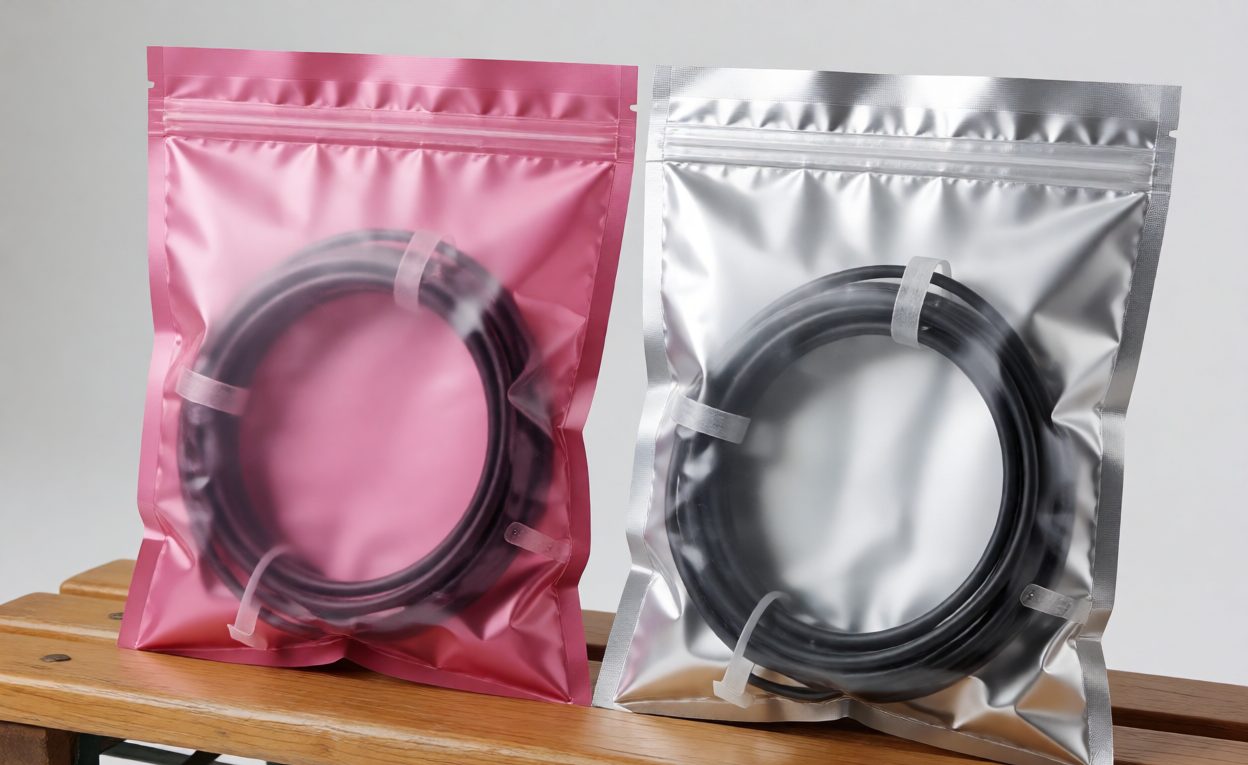
- Antistatic bags. Treated to avoid generating a charge when rubbed. They do not shield against an external discharge. Suitable where the concern is tribocharging, not field exposure.
- Static shielding bags. A conductive metal layer that forms a Faraday cage around the contents. The correct choice where an assembly contains active electronics.
- Conductive bags and bins. Used inside a controlled area where everything is grounded, including the handling and the bench.
- ESD foam, bubble and wraps. For cushioning inside a bag or tray where the surface itself should not charge.
- Shielding trays and clamshells. For connector-heavy assemblies where the contacts should not touch anything, and where a bag alone would let parts abrade.
The specification should name the type, not just the word ESD. “Pack in ESD-safe bags” produces whatever the supplier has on the shelf, which is usually the cheapest antistatic bag, which is the wrong item if there is a chip inside the connector.

Cleanroom Handling and Cleanliness
Clean requirements are a separate axis from ESD and are frequently confused with it. Cleanliness is about particles, outgassing and residue, and it matters where the assembly is installed into a process chamber, an optical path, a vacuum system or a sterile field. The relevant properties are the materials used, how they are cleaned, and how the assembly is packed after cleaning.
The practical requirements usually resolve into a handful of items: cleaning with a specified solvent or deionized water, drying in a controlled area, packing under a stated cleanliness class, double bagging with the inner bag opened in the cleaner zone, and materials chosen for low outgassing. Jackets and moldings matter here too, because a standard PVC compound and a standard adhesive label are both sources of residue that a semiconductor or optical customer will not accept.
Ask two questions of any supplier claiming cleanroom capability. What class is the packing area actually maintained at, and is the cleaning process documented with a record tied to the batch? A cleanroom garment in a photograph is not a controlled process, and the difference shows up as particle counts on the customer’s incoming inspection.
Technical Background
The phenomenon being controlled is electrostatic discharge, the sudden transfer of charge between two objects at different potentials, which is managed in practice through grounding, dissipative materials and shielding. The controlled environment itself is a cleanroom, classified by the number and size of particles permitted per volume of air rather than by how clean it looks. The packaging used to protect sensitive items in transit includes antistatic bags, whose conductive or dissipative layers keep charge from building on the surface or reaching the contents.
Specifying It in the Purchase Order
- Name the packaging type. Antistatic, static shielding or conductive, with the tray or clamshell where contacts need protection.
- State the ESD handling requirement. Grounded bench, wrist straps, and whether an ESD audit of the process is required.
- State cleanliness separately. Cleaning method, packing class, double bagging, and low-outgassing material restrictions.
- Require labeling that survives. Bag and carton labels identifying the part, the lot and the packaging class, applied so they do not smear or shed.
- Ask for evidence with the shipment. A packing record or certificate of conformance referencing the packaging requirement for that batch.
- Confirm the shipping outer. ESD inner packing inside a normal corrugated carton is fine; the requirement is about the assembly environment, not the truck.

Packaging requirements belong in the same document as the drawing, not in an email at shipment time. They affect material cost, packing labor and inspection, and a requirement added after production is finished means unpacking and repacking every unit at somebody’s expense.
General packing and carton marking is covered in bulk shipment packaging and labeling, and the wider documentation evidence chain in RoHS, REACH and safety marks for cable buyers. Where the assemblies are built to a controlled process, the sequence is described in the custom cable assembly process, and defect expectations in PPM defect rate targets. Material restrictions that drive clean requirements are set out in industrial cable materials.
Frequently Asked Questions
Does a passive cable assembly need ESD packaging?
Usually not on its own. It matters when the assembly contains active electronics or mates directly to sensitive equipment.
What is the difference between antistatic and static shielding bags?
Antistatic bags resist generating charge; shielding bags add a conductive layer that blocks external discharge.
Does a USB-C e-marker chip change the requirement?
Yes. Any active device inside the connector makes static shielding packaging appropriate rather than plain antistatic.
Is cleanroom packing the same as ESD packing?
No. ESD controls charge, cleanliness controls particles, outgassing and residue. Both can be required at once.
How should cleanliness be specified?
By cleaning method, the packing area class, double bagging, and restrictions on materials that shed or outgas.
What evidence should come with the shipment?
A packing record or certificate of conformance referencing the packaging requirement and the batch it applies to.
Can ESD inner packing go inside a normal carton?
Yes. The requirement concerns the assembly and installation environment, not the transport outer.