

Two competent suppliers can quote the same cable assembly a third apart, and neither is padding. They are making different assumptions about connector brand, conductor construction, labour method and test coverage. A buyer who only compares the bottom line cannot tell whether the cheaper quote is better buying or simply less product.
Understanding the build-up turns the quotation into a specification document. Each line corresponds to a decision someone made, and most of those decisions are the buyer’s to make.
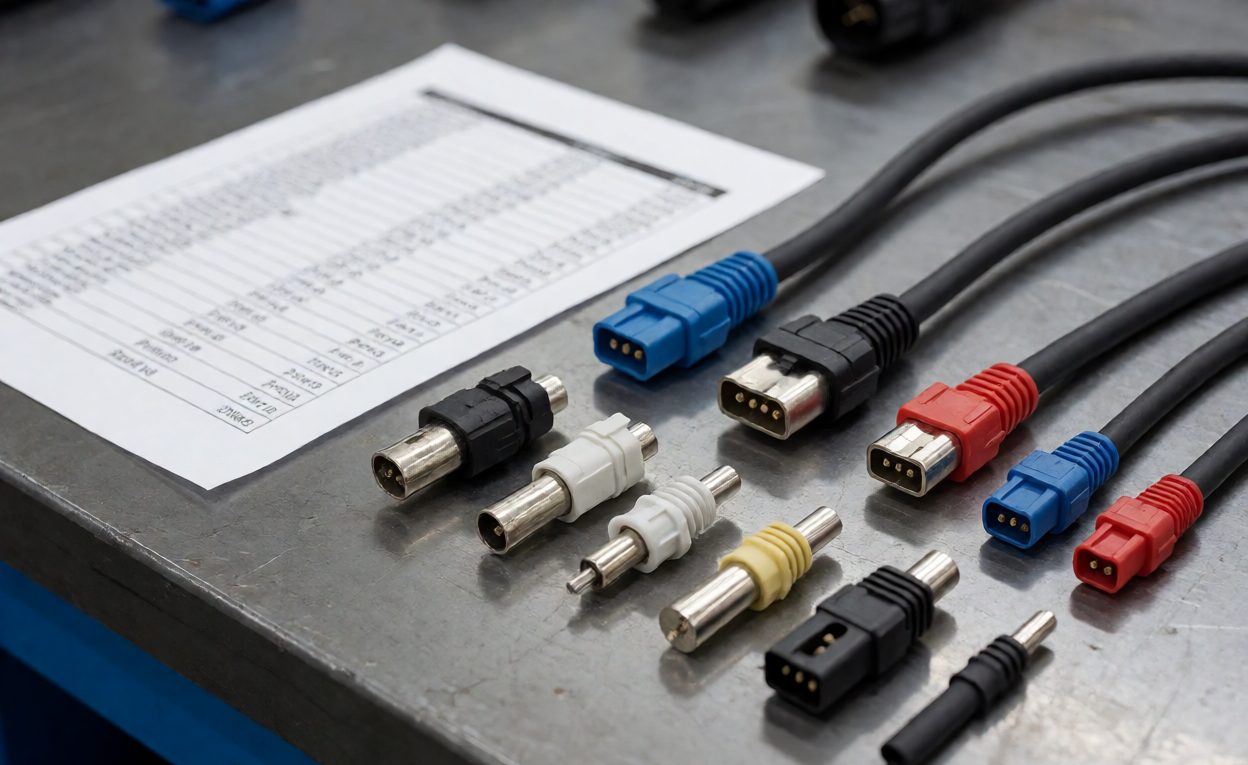
The Four Cost Blocks
Connector and component cost. Usually the largest single block, and the most sensitive to brand and plating. A branded connector with a specified plating thickness costs several times a generic equivalent, and for a mating-critical or high-cycle application the difference is justified. For a low-cycle internal link it may not be.
Cable and raw material. Conductor gauge and stranding, jacket material, shielding construction and any special rating such as flame retardancy or low halogen. Material cost scales with length, so it is the block most affected by length tolerance and by over-specification.
Labour and process. Hand assembly versus semi-automatic versus fully automated termination, plus stripping, soldering or crimping, moulding or overmoulding, and any potting or sleeving. Labour scales with the number of termination points and with how awkward the assembly is to handle.
Test, quality and overhead. Electrical test coverage, visual inspection criteria, documentation, certification maintenance and scrap allowance. Buyers rarely see this block explicitly, which is why a quote with full test coverage looks expensive next to one without it.

How Price Tiers Are Built
A tier schedule is not a discount curve; it is a reflection of which costs are fixed per order. Setup, programming, test fixture preparation and first-article checks cost the same whether the order is 200 or 2,000 units, so they are spread across more units at higher volumes. Connector and cable purchases also improve with quantity breaks from the component supplier.
This is why the first tier jump is usually the steepest. Going from 100 to 500 units amortises setup five times better; going from 5,000 to 10,000 mainly captures material breaks and line efficiency.
The practical consequence for a buyer is that consolidating orders is often cheaper than splitting them, even when the split matches cash preferences better. Where a programme needs staged deliveries, asking for one production run with scheduled releases captures the volume pricing without taking all the stock at once.
Cost Reductions That Do Not Hurt Performance
The most reliable savings come from removing over-specification rather than from negotiating:
- Length tolerance. A tight tolerance on a long assembly forces cutting waste and handling time. Where the application allows, a wider tolerance lowers price without affecting function.
- Plating and brand substitution on non-critical connectors, validated by a mating-cycle and corrosion requirement rather than by habit.
- Jacket material matched to environment: a high-flex or flame-retardant compound costs more and is unnecessary for a fixed internal run.
- Standard geometry: right-angle or unusual exit angles add handling steps; a standard straight exit with a service loop often works.
- Reducing distinct part numbers. Ten variants of the same assembly cost more than one, because each carries its own setup and documentation.

Technical Background
A supplier’s price is derived from its bill of materials plus the process steps applied to it. The quantity effect buyers see in tier schedules is an instance of economies of scale, where fixed costs are spread across more units. Comparability between suppliers depends on the request for quotation defining the same scope, which is why vague enquiries produce wildly divergent prices.
How to Make Quotations Comparable
Send the same package to every supplier and require the price to be broken out by block: connector, cable, labour, test, and any non-recurring charges. Ask them to state what is excluded – tooling, samples, freight, certification – because exclusions are where comparisons break down.
It is also worth asking how the supplier handles a specification change after quoting. A price quoted against a defined drawing will move if the drawing moves, and suppliers differ in whether they absorb small changes or re-quote the job. Knowing that in advance prevents the awkward conversation where a minor revision produces an entirely new price.
Then compare on three numbers, not one: unit price at your real annual volume, total cost including non-recurring charges amortised over that volume, and lead time. A supplier who is ten percent cheaper and six weeks slower may be the worse choice for a production line.
Quotation structure connects to the MOQ, lead time and quality checklist and to realistic expectations on MOQ and lead time. Specification choices that drive material cost are discussed in cable jacket materials and in specifying wire gauge and power rating. Supplier selection criteria are covered in choosing a custom cable manufacturer.
FAQ
Why do quotations for the same cable differ so much?
Because suppliers make different assumptions about connector brand and plating, conductor and jacket specification, labour method and test coverage.
What is the largest cost block?
Usually connectors and components, particularly where a branded part with specified plating is required.
Why is the first price tier the steepest?
Because setup, programming and first-article checks are fixed per order and are spread across more units at higher volume.
Can I get volume pricing with staged delivery?
Usually yes, by ordering one production run with scheduled releases rather than several small orders.
Which cost reductions are safe?
Removing over-specification: wider length tolerance, matched plating, appropriate jacket, standard geometry and fewer variants.
Should I ask for a cost breakdown?
Yes, by block, with exclusions stated. Comparisons fail when one quote includes tooling or test coverage and another does not.
Is the cheapest quote the best value?
Not necessarily. Compare unit price, amortised non-recurring charges and lead time together.