Quick Answer (TL;DR): To choose the right custom cable manufacturer for industrial OEM/ODM projects, evaluate them across four pillars:
- Technical Compliance: Direct experience with high-speed standards, noise shielding, and industrial certifications (IPC/WHMA-A-620, UL, ISO 9001).
- Engineering & Tooling: In-house molding capabilities to reduce cost and lead times.
- Advanced Testing: Verification using Time-Domain Reflectometry (TDR) and physical environmental testing.
- Supply Chain Transparency: Clear material sourcing protocols and flexible production options.
In industrial automation, medical devices, and high-speed telecommunications, the interconnect system acts as the nervous system of your machinery. A single cable failure can halt an assembly line, costing companies tens of thousands of dollars per hour. As of 2026, the global demand for ruggedized interconnect solutions has grown by 12% year-over-year, driven by industrial IoT (IIoT) deployments and higher data rate demands. This means selecting the correct partner for your custom cable design is no longer just a purchasing decision—it is a critical engineering milestone.
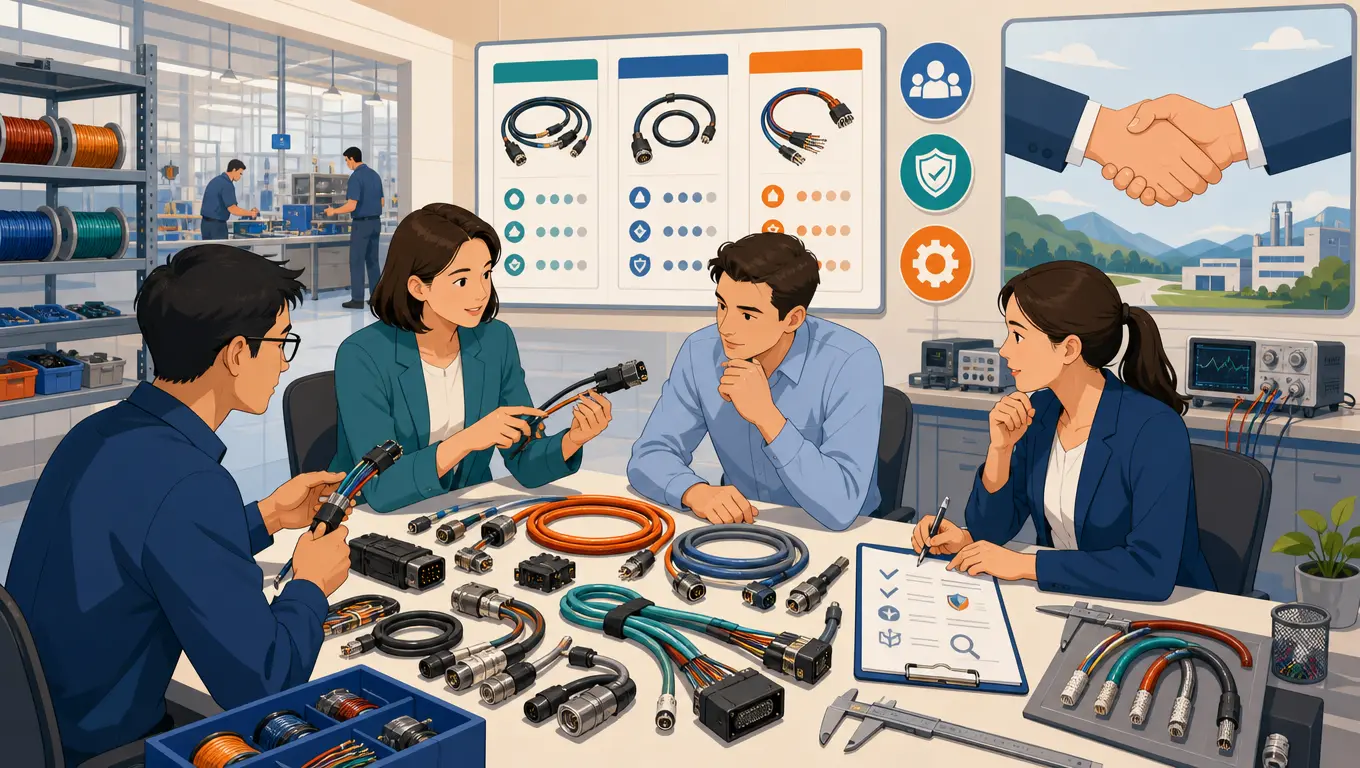
Whether you require highly specialized custom industrial cables or high-speed transmission networks, this step-by-step guide walks you through the exact process of identifying, auditing, and choosing a world-class cable manufacturer for your OEM/ODM projects.
What You Will Learn in This Sourcing Guide
- How to define technical requirements for custom industrial cables to avoid manufacturing delays.
- Critical certifications and quality control standards every elite industrial cable manufacturer must hold.
- How to evaluate a manufacturer’s prototyping, in-house tooling, and testing capacities.
- Red flags to watch out for during the RFQ (Request for Quote) and auditing phases.
Step 1: Translating Your Application Needs into Technical Cable Specifications
A common error in custom cable sourcing is providing a manufacturer with a basic “napkin sketch” or an incomplete design file. To receive an accurate quote and avoid unexpected failures, you must translate your application environment into detailed electrical and mechanical demands.
1. Electrical Requirements
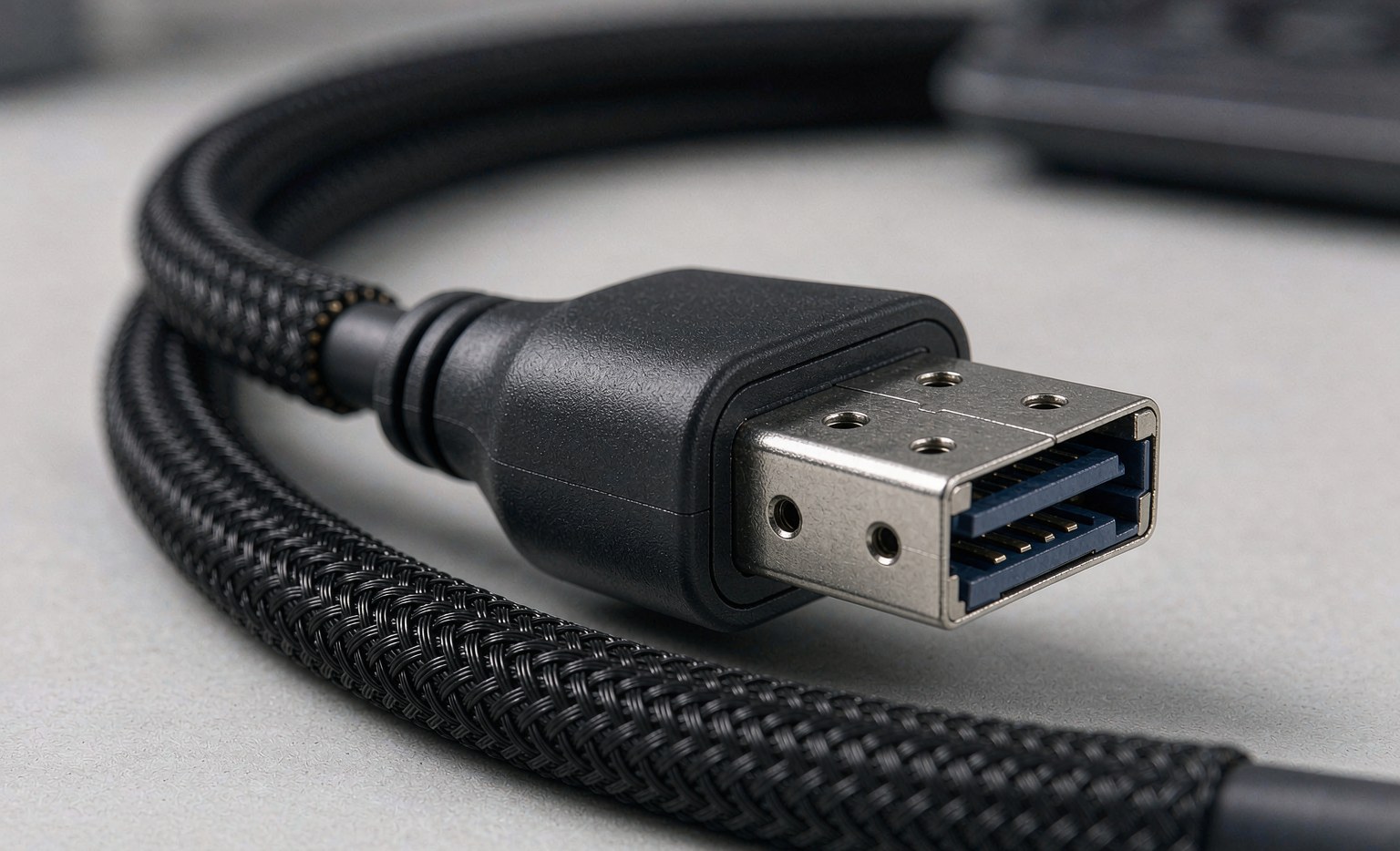
Before contacting any custom cable manufacturers, define your transmission speeds, signal integrity limits, and power requirements. High-speed systems handling PCIe Gen 5/6, SAS 4.0, or USB4 demand exceptional copper purity and precise impedance matching. For example, when routing high-frequency lines on server backplanes or RAID systems, utilizing high-precision interconnects like the SFF-8611 High-Speed Data Transfer Cable prevents signal degradation across extended runs.
2. Environmental and Mechanical Stressors
Standard consumer-grade cables quickly fail under industrial conditions. Assess the environment your cable will operate in:
- Continuous Flexing: Will the cable be installed on a multi-axis robotic arm or in a drag chain? If yes, specify continuous flex-cycle demands (e.g., 5 million to 10 million flexes).
- Chemical and Oil Exposure: Industrial environments often expose wiring to lubricants, coolants, and solvents. Jackets made from Polyurethane (PU) or Thermoplastic Elastomer (TPE) offer superior resistance over standard PVC.
- Thermal Extremes: Ensure the raw materials are rated for the operating temperatures of your machinery (typically -40°C to +105°C for rugged applications).
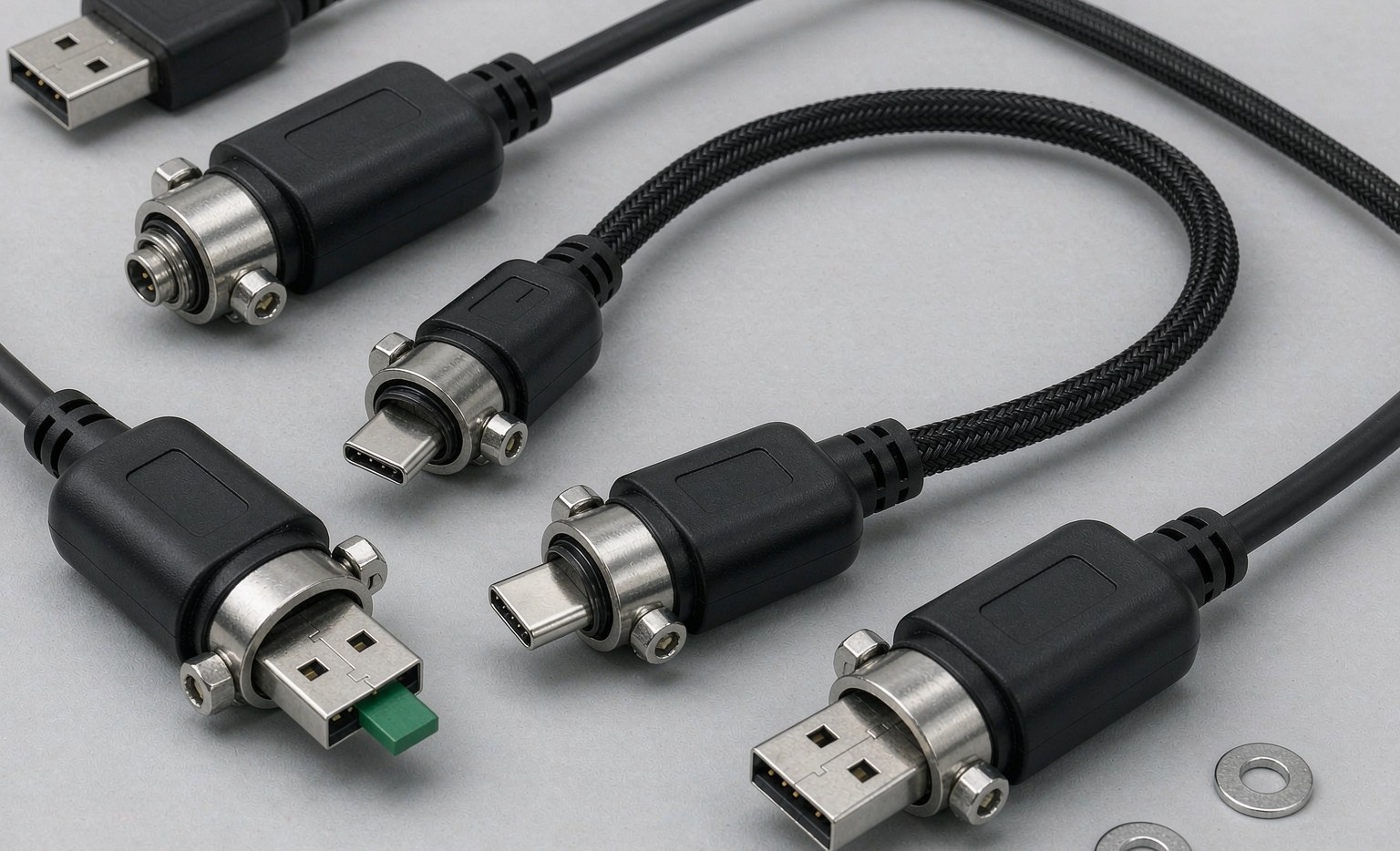
Expert Insight: For machine vision and robotics where space is limited and physical movement is constant, employing specialized molded components—such as a rugged HR10A 6-Core Molded Industrial Camera Cable—prevents strain-relief failure and maintains uninterrupted power and communication.
Step 2: Auditing Certifications and Quality Control Standards
You should never trust a partner’s word alone when it comes to reliability. Top-tier industrial cable manufacturers back their claims with international, third-party certifications. When auditing potential partners, request copies of their active certificates.
| Certification / Standard | What It Means | Why It’s Critical for OEM/ODM |
|---|---|---|
| ISO 9001:2015 | Global standard for quality management systems (QMS). | Ensures repeatable production processes and consistent quality across bulk batches. |
| UL / CSA Certification | Underwriters Laboratories safety and performance validation. | Required for compliance when selling industrial machinery in North America. |
| IPC/WHMA-A-620 | The only industry-consensus standard for Cable and Wire Harness Assemblies. | Defines the acceptability criteria for soldered, crimped, and secured connections. |
| RoHS & REACH | Restrictions on hazardous substances and chemical usage. | Mandatory for exporting machinery and electronic systems to the European Union. |
At LUNG KAY, we build our entire manufacturing and engineering workflow around these quality benchmarks. By choosing a partner who strictly adheres to IPC-A-620 guidelines, you guarantee that every crimp, solder joint, and shield termination is tested for long-term mechanical reliability.
Step 3: Evaluating Engineering Capability and In-House Tooling
A true OEM/ODM partner does more than assemble off-the-shelf components. They should offer custom engineering support starting at the design phase. If your design calls for custom connectors, heavy-duty overmolding, or unique strain reliefs, ask the manufacturer about their tooling facilities.
Many factories outsource their mold making to third parties. This introduces several risks:
- Inflated Lead Times: Waiting for external tooling shops can delay prototypes by 4 to 8 weeks.
- High Costs: Modifications to the mold become extremely expensive.
- IP Vulnerabilities: Sharing proprietary technical drawings with third-party toolmakers increases the risk of intellectual property theft.
To mitigate these risks, partner with a cable manufacturer that manages their mold design, CNC machining, and tooling maintenance in-house. This gives you the flexibility to design proprietary connectors—such as a custom SCSI 68-Pin IDC Assembly Connector for legacy automation hardware—without paying excessive tooling fees or risking design leaks.
Step 4: Insisting on Comprehensive Signal Integrity and Physical Testing
The reliability of a custom cable is only as good as the testing protocol it undergoes before leaving the factory. Ensure your potential manufacturing partner performs both electrical and mechanical testing on every batch.
Essential Electrical Verification
- Continuity and Hipot Testing: Confirms there are no short circuits, open circuits, or weak insulation points that could fail under voltage spikes.
- TDR (Time-Domain Reflectometry): Critical for high-speed cables (like USB4 or high-speed SAS). TDR measuring ensures impedance stays uniform across the run, keeping reflections and jitter within target limits. If you are sourcing high-spec power delivery cables, such as a USB4 Type-C Fast Charging Cable, TDR verifies that signal lines alongside 100W/240W power delivery lines don’t suffer from thermal or electromagnetic interference.
Physical Durability Testing
According to 2026 industrial robotics reports, physical strain and bend wear account for nearly 40% of all connector and cabling failures in smart factories. Your chosen industrial cable manufacturers should utilize specialized equipment to simulate years of heavy usage:
- Flex and Bending Test: Mechanically sweeps the cable back and forth under tension to verify jacket and conductor longevity.
- Salt Spray & Environmental Chambers: Subjects samples to extreme humidity, temperature changes, and corrosive atmospheres to verify that plating, shielding, and overmolds do not deteriorate.
Pitfalls to Avoid When Sourcing Custom Industrial Cables
When comparing proposals from various suppliers, look beyond the unit cost. Here are three common sourcing traps that lead to long-term project failure:
- Hidden “Copper Clad Aluminum” (CCA) Materials: Some lower-cost providers substitute pure copper conductors with CCA to reduce prices. CCA has higher resistance, lower mechanical strength, and cannot handle industrial power transmission without overheating.
- Rigid Minimum Order Quantities (MOQs): For specialized industrial equipment, you might only need 100 to 500 units per year. Avoid manufacturers that require astronomical MOQs (e.g., 5,000+ pieces) for custom configurations, as this ties up working capital unnecessarily.
- Lack of Direct Communication with Engineers: If your communication has to filter through multiple layers of sales representatives before reaching an engineer, design details will get lost in translation. Insist on direct access to the design engineering team.
Finding Your Reliable Interconnect Partner
Selecting the right custom cable manufacturers is about balancing technical engineering capabilities, rigorous testing, and clear communication. A reliable partner acts as an extension of your own engineering department, helping you optimize designs for manufacturability, lower production costs, and ensure long-term field reliability.
If you are planning an OEM/ODM project and need custom industrial harnesses, high-speed computer cables, or heavy-duty overmolding, LUNG KAY is ready to assist. We have spent over a decade delivering custom interconnect solutions for global markets. You can view our full design capabilities in our Product Center, learn more about our quality control processes on our About Us page, or reach out to our engineering team directly via our Contact Us page to request a technical review of your project files.
Frequently Asked Questions (FAQ)
Q: What is the typical lead time for custom cable prototypes?
A: For standard customizations using readily available materials, prototyping usually takes 1 to 2 weeks. If your design requires custom injection molding, custom metal shells, or highly specialized conductors, tooling and component sourcing can extend the prototyping phase to 3 to 5 weeks.
Q: How can I verify that my custom cable manufacturer uses authentic raw materials?
A: Always request Material Test Reports (MTRs), copper purity analysis sheets, and UL flame-resistance ratings. A professional manufacturer will readily provide trace documentation and compliance sheets (such as RoHS and REACH declarations) for every production run.
Q: Can custom industrial cables be designed with hybrid functions?
A: Absolutely. Modern industrial designs frequently leverage hybrid layouts. We can combine power lines, high-speed data pairs, fiber optic lines, and even pneumatic tubes within a single protective outer jacket to save space and simplify installation.