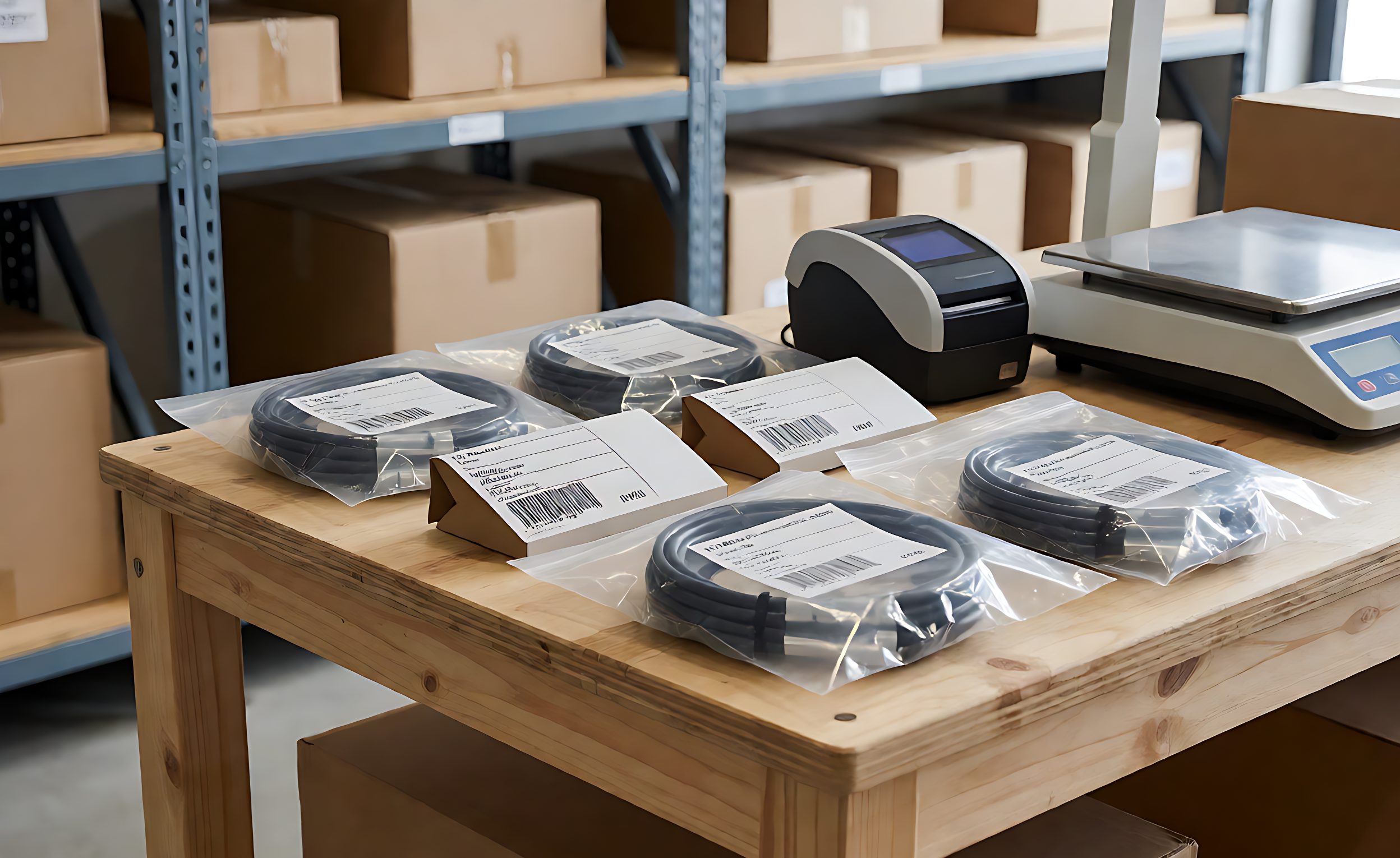
Cable assemblies are awkward to pack. They are flexible, they tangle, connector ends damage each other, and a carton of mixed part numbers is nearly impossible to verify quickly at goods-in. None of this is a manufacturing problem, but it causes a surprising share of the cost and friction in a bulk order: damaged connectors, rework at receiving, and stock that cannot be identified without opening every bag.
Packing is specified, not assumed. A short packing clause on the purchase order prevents most of it, and it costs nothing per unit. Most suppliers will follow a packing clause exactly as written, because packing is not where they compete.
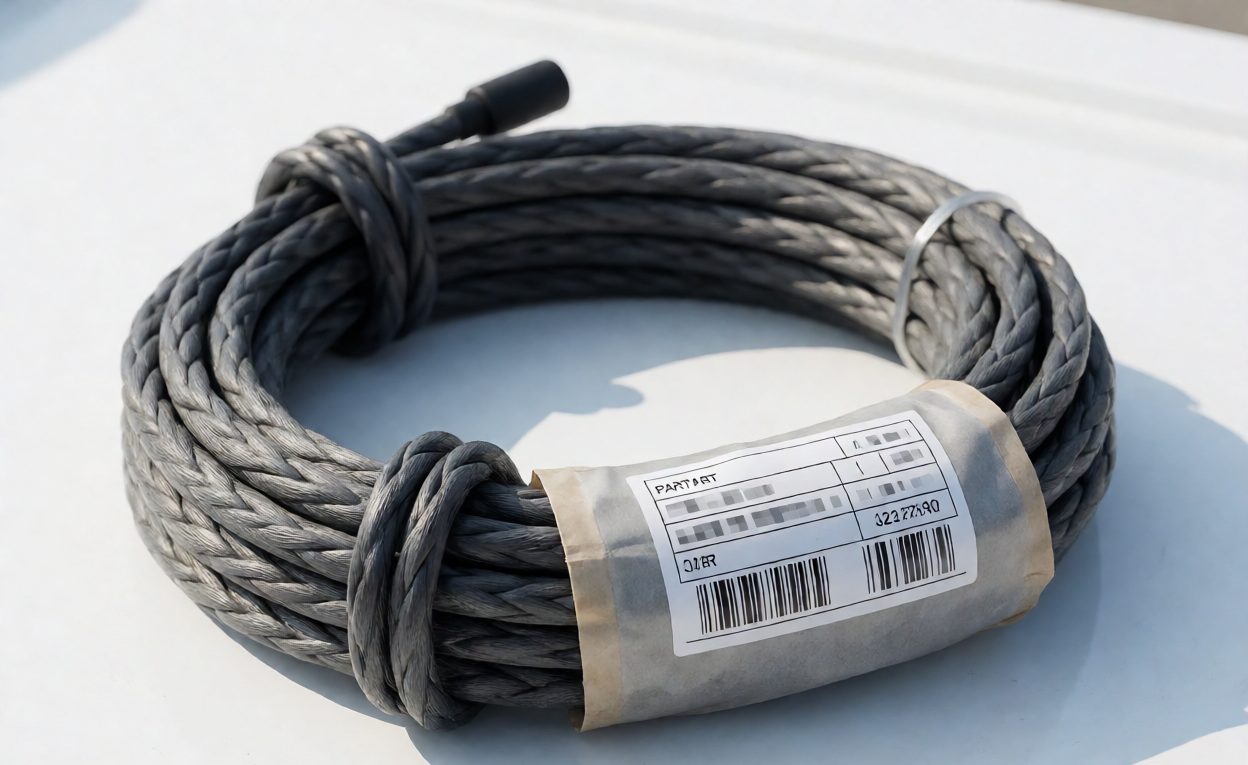
Choose the Packing Method by Product
Three methods cover most assemblies, each with a clear use case:
- Individual bags, suited to finished assemblies with connectors. Each unit is protected, labelled and countable. Slightly more labour, much faster goods-in.
- Coiled and tied, suited to bulk cable or harnesses without delicate terminations. Cheapest and most compact, but needs a consistent coil diameter so units do not arrive kinked.
- Reel or spool, suited to long continuous runs. Protects the cable and feeds a production line directly, but adds reel cost and return logistics unless the reel is disposable.
The failure mode to avoid is mixing methods within one order without saying so. A carton containing both bagged and loose units cannot be counted reliably, and the receiving team ends up hand-counting to reconcile.

What the Label Has to Say
Two labels matter: the unit label and the carton label. The unit label should carry the part number, revision, and a batch or date code. The carton label should carry the part number, quantity, purchase order reference, batch code, carton number in the sequence, and gross and net weight.
Carton sequencing – “carton 3 of 12” – is the item that makes a shipment verifiable. Without it, a missing carton is discovered by chance; with it, the receiving team knows immediately which one did not arrive.
Where the buyer’s warehouse scans barcodes, specify the symbology and the data content rather than asking for “a barcode”. A code that prints the internal factory reference rather than the buyer’s part number will not scan into the buyer’s system usefully.
Protecting the Connector Ends
Most transit damage on cable assemblies is at the termination. Connectors crush, pins bend, and overmoulded strain reliefs take set if coiled too tightly. Three specifications address it: a minimum coil diameter stated as a number rather than as “coil loosely”, connector ends protected by caps or by facing them inward in the bundle, and carton fill that prevents movement without compressing the contents.
Carton strength deserves a line too. A carton rated for its contents’ weight is not the same as one rated for stacking in a container, and cable assemblies are dense – a small carton can be heavy enough to crush the carton beneath it in a stack.

Technical Background
Packing and marking requirements belong to the wider discipline of packaging and labelling, where the pack carries identification as well as protection. Machine-readable identification is provided by a barcode, whose symbology and data content must be specified to be useful. Damage in transit is usually a function of how units are restrained within a pallet load, not merely of the carton itself.
Writing the Packing Clause
A workable clause is short: packing method per part number, coil diameter where applicable, units per bag and per carton, label content and placement for unit and carton, carton sequencing, carton strength or stack rating, and whether pallets are required. Where assemblies are sensitive, add a statement that connector ends must be protected.
Where assemblies ship with a certificate of conformity or a test report, state whether the document goes inside the carton, outside it, or is sent separately. A copy inside a sealed carton is found late; a copy sent separately is easily lost. One rule works well: a paper copy in carton one, an electronic copy on dispatch. For export shipments, add any marking the destination requires, because a compliant product in an unmarked carton can still be held.
Then verify on the first shipment rather than assuming. Photograph the packing as received, count one carton end to end, and check that the label data matches the delivery note. The first shipment sets the standard for the ones after it, and corrections are far cheaper then.
Packing interacts with quality verification at goods-in and with the test documentation discussed in the test reports an OEM should provide. Handling and bend behaviour are covered in the bend radius guide, connector robustness in connector durability, and volume planning in the MOQ and lead time checklist.
Preguntas Frecuentes
Why specify packing on a cable order?
Because flexible assemblies tangle and connectors damage each other in transit, and vague packing produces damage and slow goods-in.
What should a carton label include?
Part number, quantity, purchase order reference, batch code, carton sequence number, and gross and net weight.
Why number cartons in a sequence?
So a missing carton is identified immediately at goods-in rather than discovered later by chance.
How do I stop connector damage in transit?
State a minimum coil diameter as a number, protect connector ends, and fill the carton to prevent movement without compressing.
Is bag-per-unit worth the cost?
Usually yes for connectorised assemblies, because the saving in goods-in labour and damage exceeds the packing cost.
Do I need to specify the barcode type?
Yes. Specify symbology and data content, or you may receive a code encoding the factory’s internal reference.
Should carton strength be specified?
Yes, for stacking rather than only for contents weight, because dense cable cartons crush weaker cartons beneath them.