Strain relief is the least glamorous part of a cable assembly and the one most often implicated in field returns. It costs very little to add and very little to get wrong at the drawing stage, and its failures are slow: a conductor that fractures after months of vibration, a crimp that works loose, a seal that opens at the cable exit. By the time the symptom appears, the assembly is installed and the diagnosis is expensive.
There are two questions behind it. The design question is where the load goes: a cable that is pulled, bent or vibrated transfers that force somewhere, and the strain relief exists to spread it over a length of jacket and a molded body rather than concentrating it on a few millimeters of crimp barrel. The test question is what a pull test demonstrates, which is less than most specifications assume.

What Strain Relief Is Actually Doing
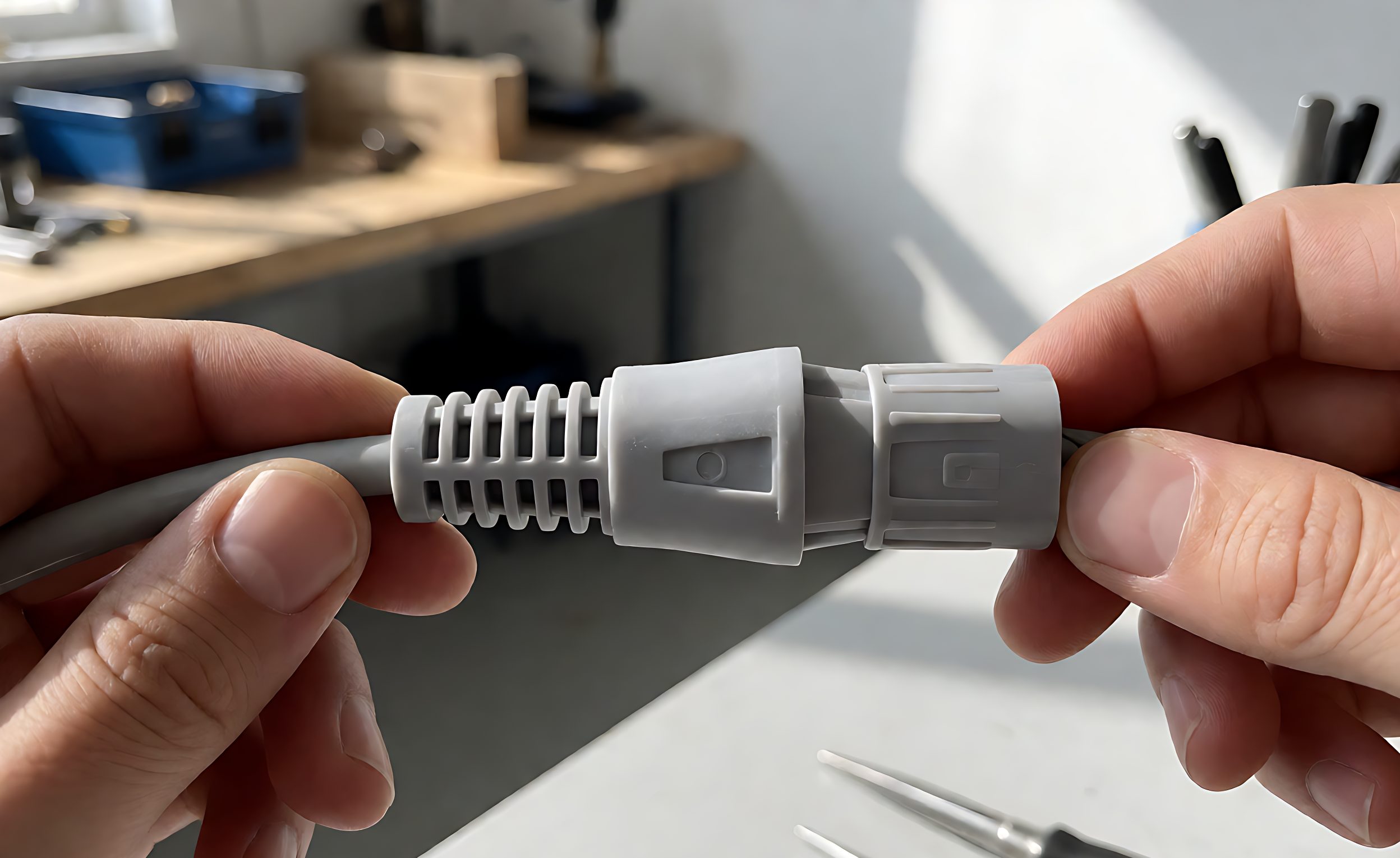
Stripped of branding, a strain relief performs four jobs, and a design should be able to name which of them matter:
- Limiting the bend radius at the termination. The stiffest part of an assembly should decide where it curves, so the curve never happens at the crimp or solder joint.
- Transferring axial load to the jacket. A pull on the cable should be resisted by the grip of the body on the jacket, not by the conductor termination.
- Sealing the cable exit. Where an ingress rating is claimed, the relief is often the surface that closes the path around the jacket.
- Stopping the assembly rotating or backing out. On threaded connectors the body frequently carries the anti-rotation feature too.
Geometry: Where the Load Goes
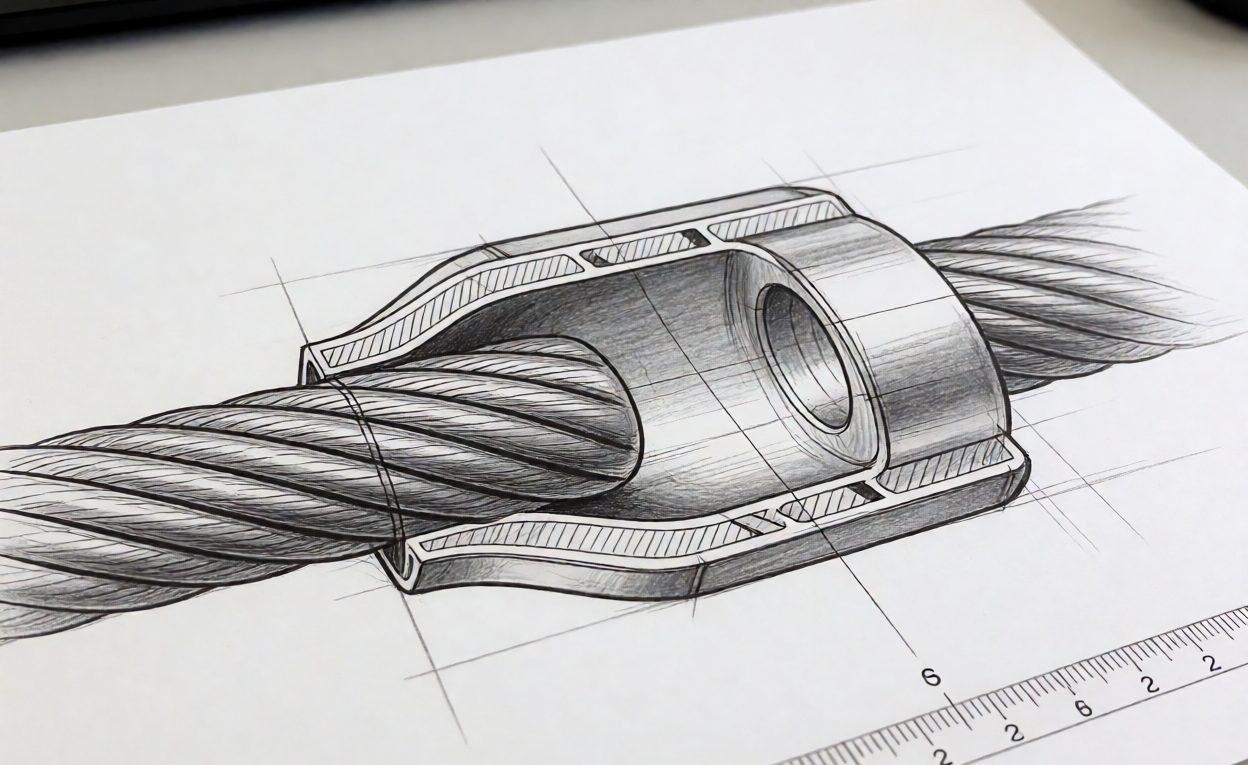
The most useful dimension on a strain relief is the length of the transition. A body that ends abruptly concentrates every bend at one point, and the cable fails there regardless of how strong the material is. A tapered transition spreads the same curvature over a longer distance, cutting peak strain in the outer strands substantially for a modest increase in length.
Grip is the second dimension that matters. The relief must hold the jacket firmly enough that an axial pull loads the jacket rather than the conductor, which means contact over sufficient length and, for slippery jackets, internal ribs or a compression feature. A glossy polyurethane jacket in a smooth bore looks fine on a drawing and slips in service.
What a Pull Test Proves and What It Does Not
A pull test is a static axial test: the assembly is held, a specified force is applied for a specified time, and the sample is checked for conductor displacement, continuity loss and visible damage. It answers the grip question well and substitutes poorly for everything else.
- It proves grip. If the jacket is retained, the load does not reach the termination.
- It does not prove flex life. One sustained pull says nothing about a cable flexed a hundred thousand times.
- It does not prove vibration resistance. Cyclic loading at low amplitude works a joint loose in a way no static test reproduces.
- It does not prove the seal. An ingress rating is verified by its own test, not inferred from a pull result.
Buyers who want confidence beyond grip should specify the additional tests by name. A flex test, a swing test and an ingress test each exist with their own fixtures, and each is cheap against a field return program.
Setting an Acceptance Criterion
A pull test requirement is enforceable only when it states the force, the duration, the direction, the sample count and the pass condition. “Withstands 50 N” is not a test; “50 N applied axially for one minute, five samples, no conductor displacement over 1 mm, continuity maintained throughout” is. The pass condition is the part most often missing, and without it a supplier’s pass and a buyer’s fail can describe the same sample.
Force levels should come from the application rather than from habit. A handheld peripheral and an industrial cable dragged across a floor live in different worlds. Where no internal figure exists, the connector maker usually publishes a cable retention value.
Failure Modes Found in the Field
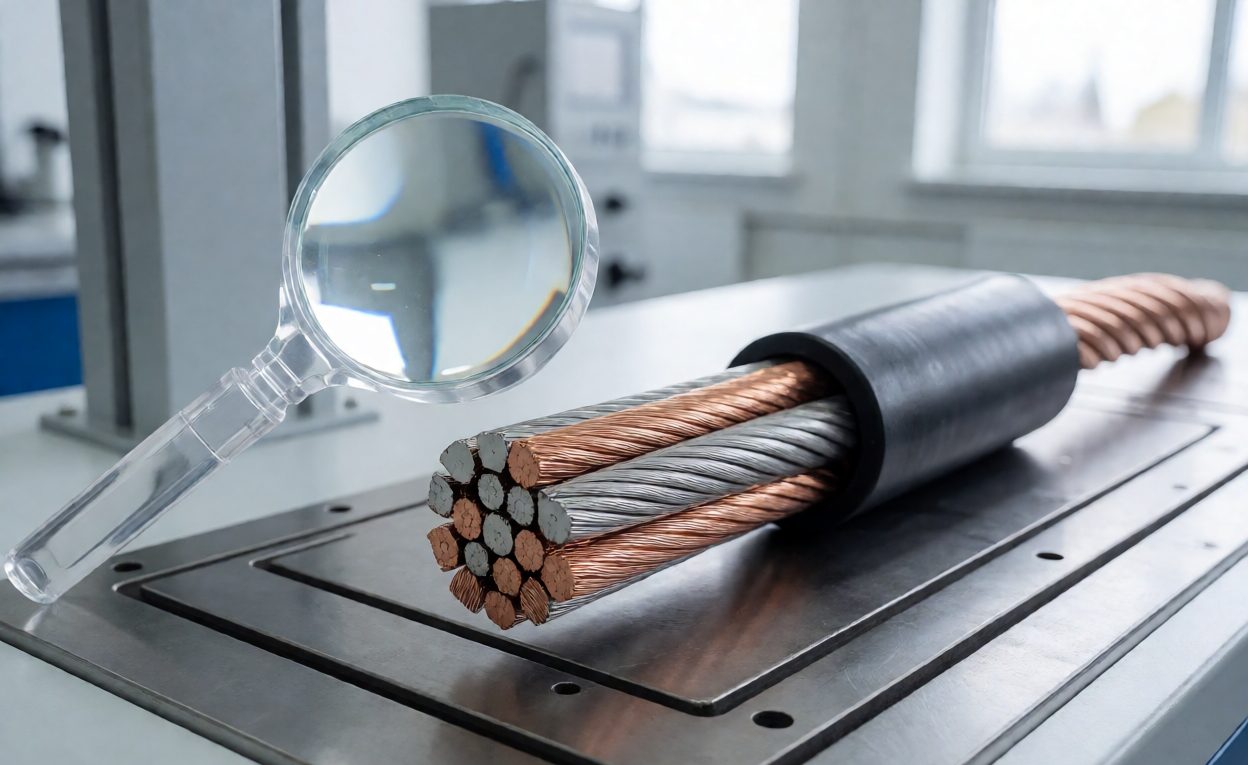
- Conductor fracture at the crimp shoulder, where an abrupt transition lets the bend start in already work-hardened strands.
- Jacket slip inside a smooth bore, which puts the full axial load onto the termination.
- Cracked molded bodies from a material too rigid for the bend the installation requires.
- Seal opening at the cable exit when the cable is pulled sideways, a direction the pull test never covered.
- Loosened connector hardware where the relief was expected to resist rotation and never did.
Technical Background
The component class is a strain relief, whose function is to move mechanical load away from an electrical joint. The verification method is tensile testing adapted to a terminated assembly. What a static test misses is material fatigue, where repeated small loads cause a fracture no single application would.
Making the Requirement Enforceable
Put the test on the drawing with its numbers, ask for the result in the test report rather than a statement of compliance, and retain a sample from the first article build. Where the assembly is sealed, pull-test a sample after the ingress test, because gaskets and sealing compounds change how the body grips the jacket.
Strain relief geometry overlaps with the molding choices in overmolding and strain relief assemblies and the tooling economics in overmold design and tooling cost. Test evidence belongs in the package set out in the cable assembly test report, and the recurring patterns are catalogued in cable assembly failure analysis.
Perguntas Frequentes
What does a cable pull test actually prove?
That the strain relief grips the jacket well enough to keep axial load off the termination, at the stated force and duration.
Does passing a pull test mean the cable will survive flexing?
No. Flex life is a separate cyclic test governed by stranding, transition length and jacket material.
What should a pull test specification state?
Force, duration, direction, sample count and a measurable pass condition such as maximum conductor displacement.
How much force is appropriate?
Set it from the application, or start from the connector manufacturer’s published cable retention figure.
Why does cable slip inside the strain relief?
Insufficient grip length or a smooth bore against a low-friction jacket; ribs or compression features usually fix it.
Where do conductors usually break?
At the crimp shoulder, where an abrupt transition lets the bend begin in work-hardened strands.
Should the pull test run before or after sealing tests?
After, for sealed assemblies, because gaskets and sealing compounds change how the body grips the jacket.