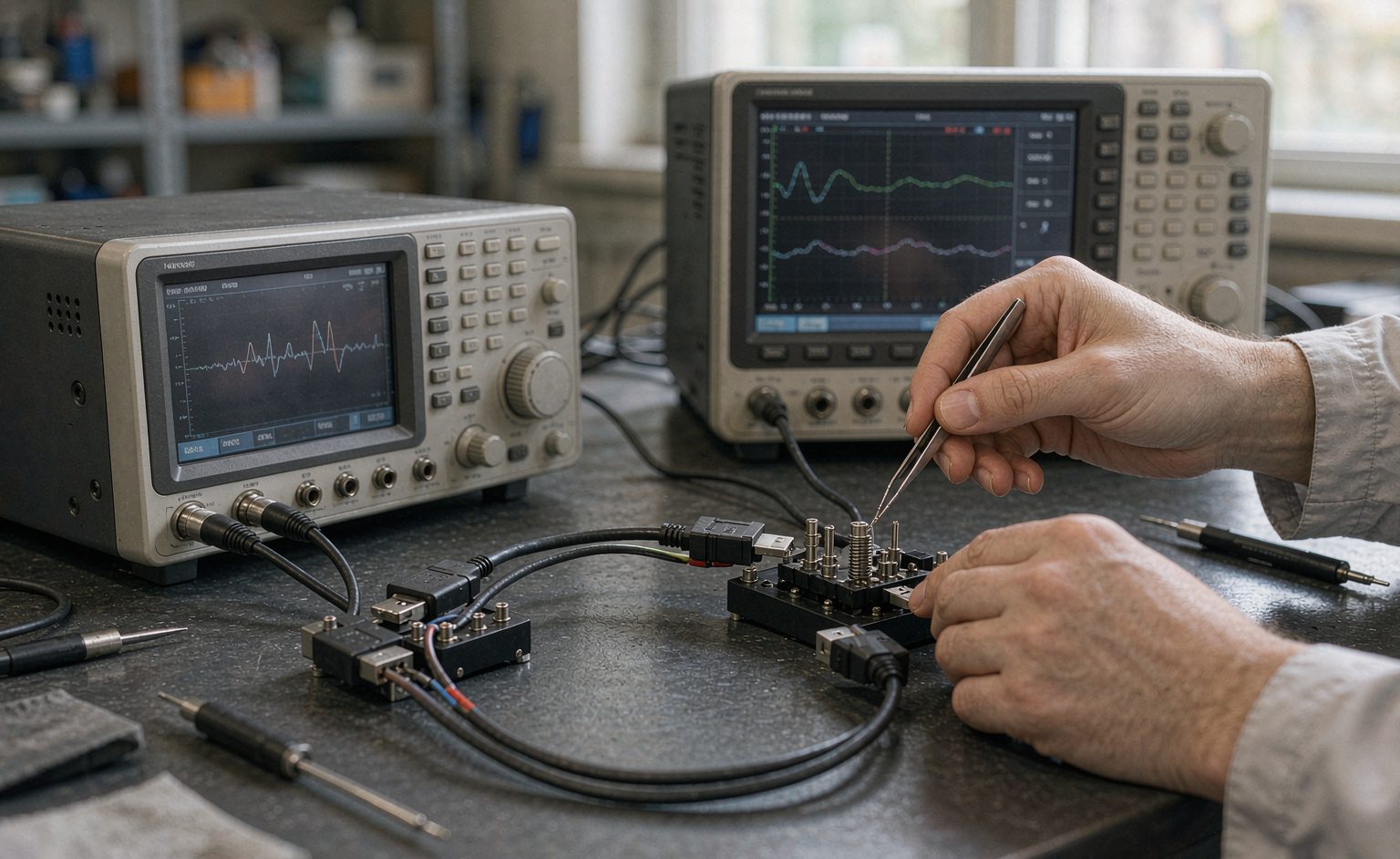
A cable without a test report is an assertion. The assembly looks identical whether every conductor terminated correctly or one is making intermittent contact, and the difference surfaces months later as the fault that cannot be reproduced. The test report is the only evidence that separates a built cable from a working one, and knowing which tests matter tells you whether a supplier has a process or a promise. This guide covers the set.
Puntos clave
- Continuity and insulation resistance are per-unit tests; signal integrity is sample-based.
- An eye diagram is the signal-integrity evidence that matters for high-speed links.
- Ask which tests are per-unit and which are sample-based, and get it in writing.
- Reports must reference the exact part number and length ordered.
- A supplier who cannot produce a sample document package is describing a process, not demonstrating one.
The Core Test Set
Five tests cover most cable assemblies, and each answers a different question.
| Prueba | What it verifies | Typical basis |
|---|---|---|
| Continuity / wire map | Every conductor terminates to the correct pin | Per unit |
| Insulation resistance | Dielectric integrity between conductors | Per unit |
| Hipot / dielectric withstand | No breakdown at the rated voltage | Per unit or sample, by class |
| Signal integrity / eye diagram | The link performs at the rated generation | Sample-based |
| Environmental | Flex, temperature, chemical exposure | Sample-based, by requirement |
The per-unit versus sample-based distinction is the one to establish first, because it determines what a passing report actually says about the unit in your hand. A per-unit continuity result covers every assembly; a sample-based eye diagram covers the design, not that specific cable. The continuity method is described in continuity testing references.
Eye Diagrams and Signal Integrity
For high-speed links, the eye diagram is the evidence that matters most.
| Elemento | What it shows | What to ask |
|---|---|---|
| Eye height | Vertical margin against noise | Measured height at the rated length |
| Eye width | Timing margin against jitter | Measured width at the rated length |
| Length dependence | How margin degrades with length | Results at your ordered length, not a shorter one |
| Test conditions | Equipment, rate and configuration used | The conditions, so results are comparable |
The length-dependence row is the one most often omitted. A cable tested at a shorter length performs better than the same construction at your ordered length, so a report at the wrong length overstates the margin. The measurement concept is explained in eye pattern references, and the length limits themselves in our cable length and signal integrity guide.
Reading a Report
Four elements turn a document into evidence.
| Elemento | Why you need it |
|---|---|
| Exact part number and length | Results apply to a part, not a product family |
| Test standard and method | Makes results comparable between suppliers |
| Results with units and conditions | A pass without conditions is not interpretable |
| Lab identification | Who tested, and whether they are accredited |
Ask for a sample document package before the bulk order. A supplier who produces reports traceable to a part number is demonstrating a process; one who offers a generic certificate is describing one. The document set expected across a custom program is set out in our custom cable assembly process guide.
What to Ask Before Ordering
Four questions establish whether the supplier can support the order.
| Question | What a good answer looks like |
|---|---|
| Which tests are per-unit? | A named list, typically continuity and insulation resistance |
| Which are sample-based? | A named list with the sampling basis stated |
| What comes with the shipment? | A batch report plus a certificate referencing it |
| Can I see a sample package? | An actual report for an actual part number |
These four answers are also the fastest way to compare two suppliers on quality rather than on price. The specification fields that determine which tests apply are covered in our guide to specifying an assembly that delivers, and the connector-level specification in our SlimSAS specification guide. The dielectric test behind insulation resistance is described in insulation resistance references.
Preguntas frecuentes
What test reports should a cable supplier provide?
At minimum continuity and insulation resistance per unit, plus signal-integrity verification for high-speed links. Environmental and safety testing where the application or market requires it.
Which tests are run on every unit?
Usually continuity and insulation resistance. Signal integrity and environmental testing are typically sample-based. Ask for the split in writing.
What is an eye diagram test?
A signal-integrity measurement showing vertical and timing margin at the rated rate. It is the standard evidence that a high-speed link will perform at the ordered length.
Why does test length matter?
Because margin degrades with length. A report at a shorter length overstates the performance of the cable you actually ordered.
Can I rely on a product-family certificate?
No. Reports apply to a specific part number and length. A family-level claim tells you nothing about the specific assembly in your shipment.
How do I compare two cable suppliers on quality?
Ask which tests are per-unit, which are sample-based, what documents come with the shipment, and to see a sample package for a real part number.
What should arrive with a bulk cable shipment?
A batch test report, a certificate of conformance referencing it, and lot numbers that match between labels and paperwork.
Antecedentes técnicos: continuity testing, eye patterns y insulation resistance explain the test methods referenced above.