
Color is the cheapest way to make a cable assembly fail-proof for the person installing it, and one of the most misunderstood line items in an OEM quote. Buyers ask for a specific jacket color expecting paint-shop logic, then discover dye lots, material constraints and MOQ jumps. This guide explains when custom colors are worth it, what they actually cost, and the marking alternatives that solve most identification problems at a fraction of the effort.
Start by separating two different goals: identification in the field and brand appearance. Identification rarely needs a full custom color — a standard color plus a printed marker usually wins on every axis. Appearance goals like matching a device housing are where custom jacket colors earn their keep, and where the MOQ and lead time discussion gets specific.

Standard Color Conventions Do Real Work
Before customizing, respect what exists. Power conductors follow line-neutral-earth conventions that are regulated in most markets, and data cabling has its own habits — black for power, grey for data, blue or orange for particular protocol families in many racks. If your assembly lives inside equipment that technicians service, deviating from a convention they know creates mis-termination risk that no brand guideline justifies.
Inside a single product, color coding earns its keep when two or more identical connectors sit side by side and the wrong pairing damages something. That is the case where a second jacket color is not cosmetic but functional, and it is the strongest argument for paying the custom-color premium.

What a Custom Jacket Color Actually Costs
Jacket color is not paint applied to finished cable; it is pigment compounded into the jacket material during extrusion. That single fact explains most of the price behavior:
- Compound minimums: colorant must be ordered and compounded in batches. Small volume runs carry a compounding charge that looks huge per metre at low quantities.
- Material interaction: the same pigment behaves differently across PVC, low-halogen and TPE jackets, which is why a color matched on one jacket material will not transfer directly to another.
- MOQ thresholds: standard colors run at any quantity; custom colors typically become economical in the range where a full compound batch is consumed, often a few thousand metres depending on jacket thickness and cable diameter.
Technical background: jacket color comes from pigment compounded into the polymer before extrusion, and color agreement between buyer and factory is usually written in the CIELAB color space, where “the same color” becomes a number with a tolerance instead of an opinion. Compounders may also use colorant terminology you will see on spec sheets and batch documents.
Batch-to-Batch Consistency and Approval Samples
Color drift between orders is the classic failure. The fix is procedural, not heroic: approve a physical color chip from the production compound, write the Lab values into the drawing, and require first-article comparison against that chip on every repeat order. Photographs are not enough — screens lie, and a photo of a jacket on a phone at night proves nothing.
- Ask for the compound batch number on every shipment’s COA so a drift can be traced.
- For multi-plant programs, confirm both plants compound from the same master batch, not from separate matches to the same chip.
- For two-color programs, order both colors in the same production window; separate windows months apart are where visible drift appears in one device’s cable set.

Marking Alternatives That Avoid the MOQ Cliff
If the driver is field identification rather than appearance, three alternatives deliver most of the benefit at small quantities:
- Printed heat-shrink markers near each connector — text or symbols, applied in assembly, no extrusion impact.
- Colored connector overmolds — the mold color changes per batch while the jacket stays standard, which shifts customization to a component you may already be customizing.
- Colored cable ties, sleeves or tags — trivially cheap, but less durable in flex zones.
These options also survive the drawing-to-sample-to-bulk process faster, because they do not add a compounding and extrusion qualification step. Reserve jacket color for programs where the color itself is part of the product’s identity or its safety logic.
Packing Colored Cables for Export
Two practical notes. First, light-colored jackets — white, light grey, pastels — scuff and pick up marks from dark co-ex packed items, so request separate polybags or interleaving for light colors. Second, colors can shift slightly with heat aging; if the assembly will sit near a heat source, ask for a post-aging color comparison in the test report package so the color you approved is the color that ships a year later.
What MOQ should I expect for a custom cable jacket color?
It depends on jacket thickness and cable diameter because the driver is compound consumption, but custom colors typically become economical once a program consumes a full pigment compound batch — commonly a few thousand metres. Below that, expect a compounding surcharge or a marker-based alternative.
Can you match a color from a photo or a Pantone number?
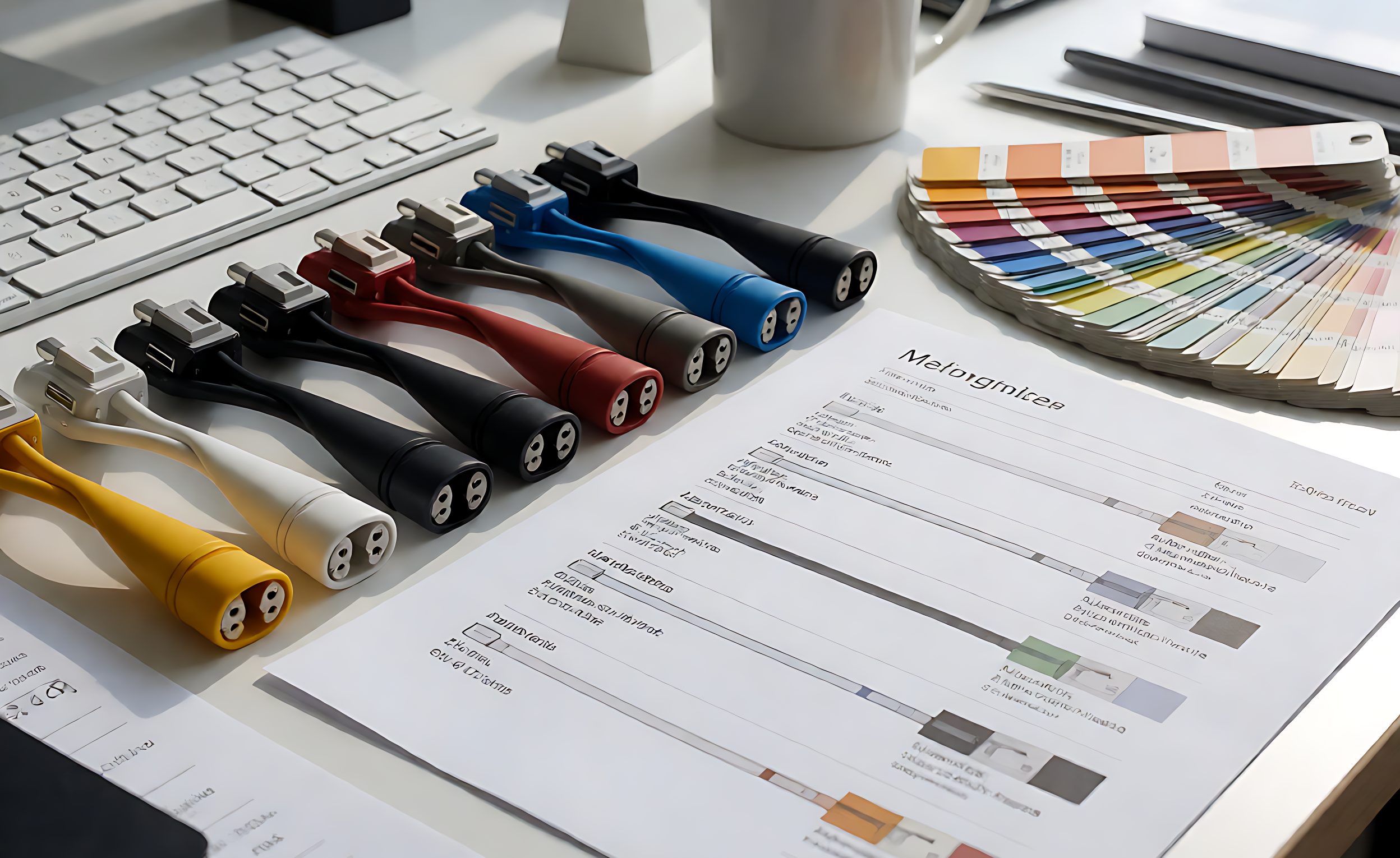
A Pantone reference is a starting point, not a spec. Pigments behave differently in different jacket materials, so the process is: match to the reference, produce a physical chip in the actual compound, approve it, then write the Lab values into the drawing.
Why did my second order come in a slightly different shade?
Most likely a different compound batch or a different plant matching to the same chip separately. Fix it with master-batch control: require the same master batch for both orders, or first-article comparison against the approved chip with the batch number on the COA.
Is a custom jacket color available on low-halogen material?
Usually yes, but the pigment library is narrower because colorants must not compromise the low-halogen or flame performance of the compound. Expect fewer options and confirm the color on the actual low-halogen material, not on standard PVC.
Do colored jackets affect cable performance?
Electrically, no. Mechanically, a poorly dosed pigment can affect jacket flexibility or flame rating, which is why the color change should go through the same qualification as any material change, with the relevant reports repeated.
What is the cheapest way to identify identical connectors in the field?
Printed heat-shrink markers near each connector. They carry text or symbols, apply during assembly, need no extrusion changes, and work at low quantities where custom jacket colors are uneconomical.
Should light-colored jackets be packed differently?
Yes. White and pastel jackets scuff against dark items in the same carton, so separate polybags or interleaving keep them clean. This is a packing instruction worth writing into the purchase order rather than hoping the factory defaults to it.