In the modern era of home entertainment and professional computing, one cable rules them all. You see it behind your television, your gaming console, and your computer monitor. But what is an HDMI cable, exactly?
HDMI stands for High-Definition Multimedia Interface. It is a proprietary audio/video interface for transmitting uncompressed video data and compressed or uncompressed digital audio data from a compliant source device to a compatible computer monitor, video projector, digital television, or digital audio device. Unlike older analog cables that required separate wires for video and audio, HDMI combines everything into a single, convenient cable.
At Longkai Electronics, established in 2012, we have witnessed the evolution of digital transmission firsthand. As a manufacturer serving global clients like Samsung and LG, we understand that the humble HDMI cable is actually a sophisticated piece of engineering essential for the 4K and 8K era.
How Does an HDMI Cable Work?
To understand what an HDMI cable is, you must look beyond the plastic coating. Inside the cable, multiple twisted pairs of copper wires transmit data using a technology called TMDS (Transition Minimized Differential Signaling). This method minimizes interference and allows for high-speed digital transmission.
When you plug an HDMI cable into your device, a “handshake” occurs. The source (like a Blu-ray player) reads the EDID (Extended Display Identification Data) of the display (your TV). They agree on the best possible resolution and audio format. This intelligent communication is why HDMI is so user-friendly—it is effectively “plug and play.”
The Evolution of Speed: HDMI Versions
Not all HDMI cables are created equal. Physically, they may look the same, but their internal bandwidth capabilities define what they can do. This is a critical distinction for consumers and industrial buyers alike.
HDMI 1.4 (Standard / High Speed)
Introduced years ago, this version supports 1080p resolution perfectly and can handle 4K resolution at 30Hz. It is sufficient for basic cable TV boxes but lacks the speed for modern high-end gaming.
HDMI 2.0 (Premium High Speed)
This became the standard for the 4K era. It increased bandwidth to 18 Gbps, allowing for 4K video at 60Hz. If you are streaming HDR content or playing games on a PS4 Pro or Xbox One X, this is the baseline standard.
HDMI 2.1 (Ultra High Speed)
The latest major standard. It boosts bandwidth massively to 48 Gbps. This supports resolutions up to 8K at 60Hz and 4K at 120Hz. For the latest consoles (PS5, Xbox Series X) and high-end PC graphics cards, an HDMI 2.1 cable is essential to unlock full performance.
Explore our wide range of consumer cable solutions to find the right connectivity for your devices.
Connector Types: Size Matters
While the “standard” HDMI connector is what most people recognize, there are smaller variants designed for portable devices.
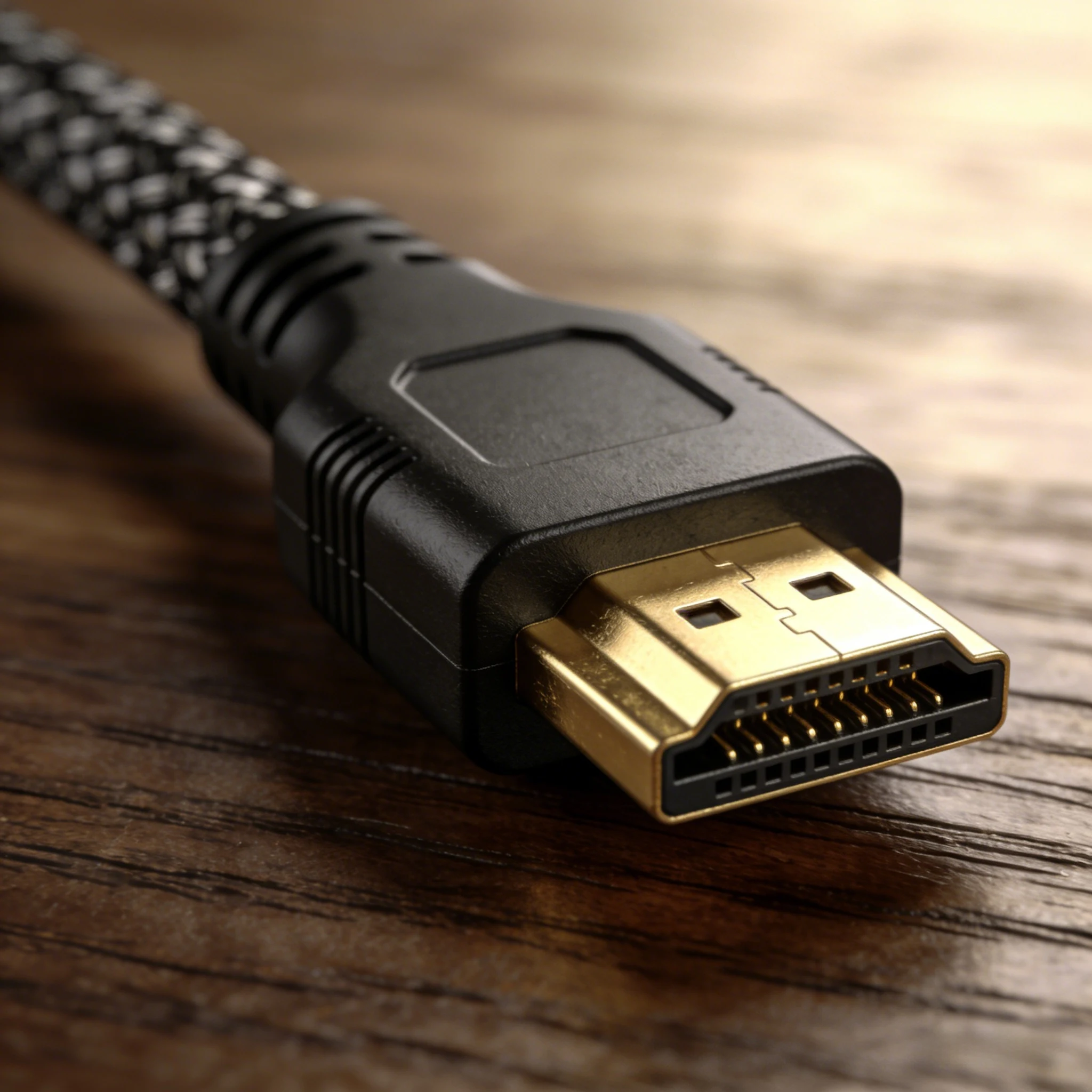
- Type A (Standard): The common connector found on TVs, laptops, and consoles.
- Type C (Mini HDMI): Smaller than Type A, often used on DSLR cameras and some older tablets.
- Type D (Micro HDMI): The smallest version, similar in size to a Micro-USB, used on action cameras like GoPros.
HDMI vs. DisplayPort: What’s the Difference?
When asking “what is an HDMI cable,” users often confuse it with DisplayPort (DP). While both transmit digital video, they serve different markets.
HDMI is the king of consumer electronics (TVs, projectors, home theater). DisplayPort is the standard for computer monitors and IT infrastructure. For industrial applications requiring locking mechanisms, DisplayPort is often preferred, but HDMI remains the universal standard for video compatibility. You can view our DisplayPort cables to compare the differences.
Advanced Features: ARC and eARC
One of the “useful content” aspects of HDMI is its ability to simplify audio. HDMI ARC (Audio Return Channel) allows your TV to send audio back to a soundbar or receiver using the same cable that receives video. The newer eARC (Enhanced Audio Return Channel) supports high-bitrate audio formats like Dolby Atmos and DTS:X, providing a cinema-quality sound experience.
Why Quality Manufacturing Matters
A cheap HDMI cable might work for 1080p, but it often fails at higher bandwidths. “Sparkles” on the screen, audio dropouts, or a black screen are common signs of poor shielding or low-quality copper.
At Longkai Electronics, we adhere to a “Quality First” philosophy. Our cables undergo rigorous testing to ensure signal integrity.
- Gold-Plated Connectors: We use gold plating to resist corrosion and ensure a stable electrical contact over years of use.
- Shielding: High-quality shielding protects the signal from electromagnetic interference (EMI), which is crucial in both home and industrial environments.
- Certification: Our manufacturing processes are ISO9001 and ISO14001 certified, and our products meet CE and FCC standards.
Conclusion
So, what is an HDMI cable? It is the lifeline of your visual experience. Whether you are watching a movie in 4K, presenting a business proposal via a projector, or integrating a display into an industrial machine, the HDMI cable handles the heavy lifting of digital transmission.
Don’t let a sub-par cable bottleneck your expensive hardware. Trust in the expertise of a manufacturer with over a decade of experience. For reliable, high-performance connectivity, explore the cable assembly solutions at Longkai Electronics.