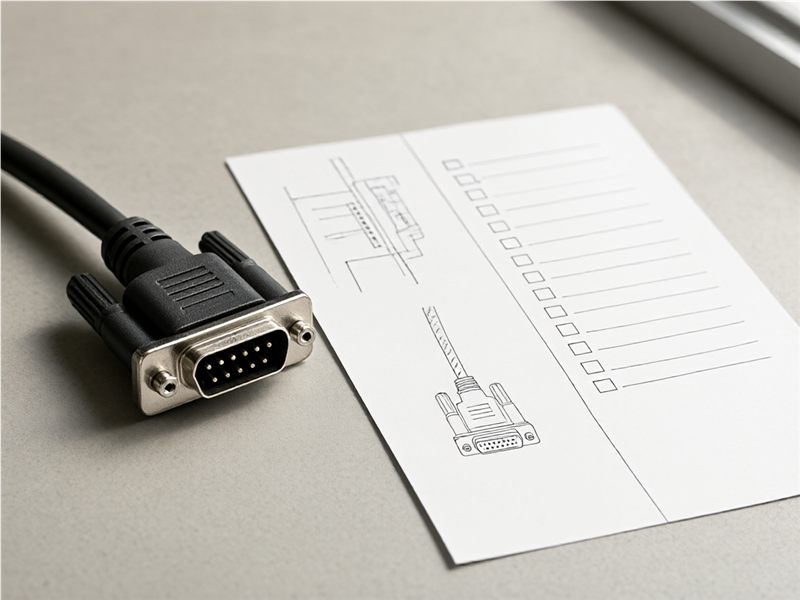

A cable assembly is rarely the part that stops a site, but it is the part that keeps a site stopped. When a terminated assembly fails, nothing local can substitute for it: the connectors, length and geometry are specific, and a repair takes days. That is why multi-site rollouts live or die on spares planning, and why the plan is better made when the production order is placed than when the first service call arrives.
The economics also favor early planning. Spares added to a production run cost little more than the unit price. The same parts ordered years later as a one-off face minimum order quantities, tooling status questions and a requalification exercise if the original design has moved.

Sizing the Spares Pool
Service demand on cable assemblies comes from three sources: random failures, handling damage during installation and maintenance, and planned changes that consume the same part. The sizing inputs are therefore:
- Population per site. How many assemblies of each part number are installed, by length and variant. Length variants matter: a three-meter assembly cannot stand in for a five-meter one in a fixed run.
- Expected service rate. Field data or supplier data on similar assemblies, expressed as failures per thousand units per year. Where data is thin, a conservative assumption costs far less than a stockout.
- Lead time to replenish. Not the production lead time quoted for new orders, but the realistic door-to-door time including minimums, export and customs.
- Consequence of downtime. A spare covering a production line justifies itself faster than one covering an office patch run.
A simple rule produces a defensible starting point: stock the larger of either one spare per site for every part number whose failure stops the site, or the expected two-year service demand, whichever is greater. Refine from actual consumption after the first year, not from opinion.
Central Pool or Local Stock
Three models exist, and most programs blend them:
- Centralized. One pool ships overnight to any site. Lowest inventory, no local shelf control, and recovery time depends entirely on logistics. Works where sites are near and downtime is cheap.
- Distributed. A minimum kit at every site, replenished from a central pool. Fastest recovery, highest inventory, and it needs local discipline – the kit that gets raided for a project is not a kit.
- Regional. A pool per region serving several sites by road freight within a day. The usual compromise for industrial rollouts spanning a country or a continent.
The decision variable is the cost of downtime versus the cost of carrying stock. Where a stopped line costs more per hour than a year of holding the spare, the spare goes on site. Where sites share a city, one regional pool usually covers them.

Standardization Is Half the Plan
The cheapest spares strategy is to need fewer part numbers. A rollout that standardizes on one assembly per function across all sites halves the spare population compared with one that lets each site specify its own lengths and connector variants. Where a choice is free – and in many cable runs a longer service loop makes length variants unnecessary – choosing the common part is worth more than any optimization of the pool afterward.
Standardization also protects the later life of the program. Fewer part numbers mean fewer minimum-order exposures when replenishing, and a documented common build that a second supplier can be qualified against if the original source changes.
Keeping the Stock Alive
Service stock decays in two ways: physically and administratively. Physically, connectors age on the shelf through plating and contact corrosion, so storage conditions and a shelf-life policy apply to spares exactly as they do to new parts. Administratively, the spare pool drifts out of date as the installed base changes: sites add equipment, lengths get revised, and the pool fills with parts that no longer fit anything while the variants actually needed are absent.
The cure is a review tied to change, not to the calendar: whenever the installed base or a drawing changes, the spare list updates with it. Stock consumption should be logged by part number and site, because the first year of real consumption is the best forecast available for the second.

Technical Background
The inventory held against uncertain demand follows safety stock logic: cover is sized against variability in demand and lead time rather than against a fixed rule of thumb. The items themselves are spare parts, whose planning differs from production planning in that demand is sporadic and the consequence of absence is downtime rather than a missed shipment. The total cost of holding cover, including storage and capital, is part of inventory economics.
Putting the Plan in Place
A workable spare plan fits on one page: the part numbers installed with populations per site, the stocking model per part, initial quantities and reorder points, storage conditions, and the owner who updates the list when the installed base changes. Agreeing replenishment terms with the supplier at the same time as the production order – reserving capacity, fixing the drawing revision, setting a reorder channel – converts the plan from paper into a working supply line.
Replenishment mechanics are described in blanket orders and scheduled releases for cable supply, shelf-life and storage detail in connector plating shelf life and storage, and the carrying-cost logic in total cost of ownership for cable assemblies. Where a second source is part of the service strategy, the qualification path is covered in second-source qualification for cable assemblies.
Frequently Asked Questions
How many spares should each site hold?
At minimum one spare of every part number whose failure stops the site, or the expected two-year demand, whichever is larger.
Central pool or local stock?
Central where downtime is cheap and logistics fast; local kits where a stopped line costs more than a year of holding the spare.
When should spares be ordered?
With the production run. Later orders face minimums, tooling questions and possible requalification if the design has moved.
Why does standardization matter for spares?
Fewer part numbers mean a smaller pool, lower replenishment minimums and a build that a second source can be qualified against.
Do spare cables degrade in storage?
Yes, mainly through connector plating and contact aging, so storage conditions and a shelf-life policy apply to spares too.
How often should the spare list be reviewed?
Whenever the installed base or a drawing changes, plus a check against actual consumption logged by site and part number.
What should a spare plan document contain?
Installed populations per site, stocking model, initial quantities, reorder points, storage conditions and a named owner.